
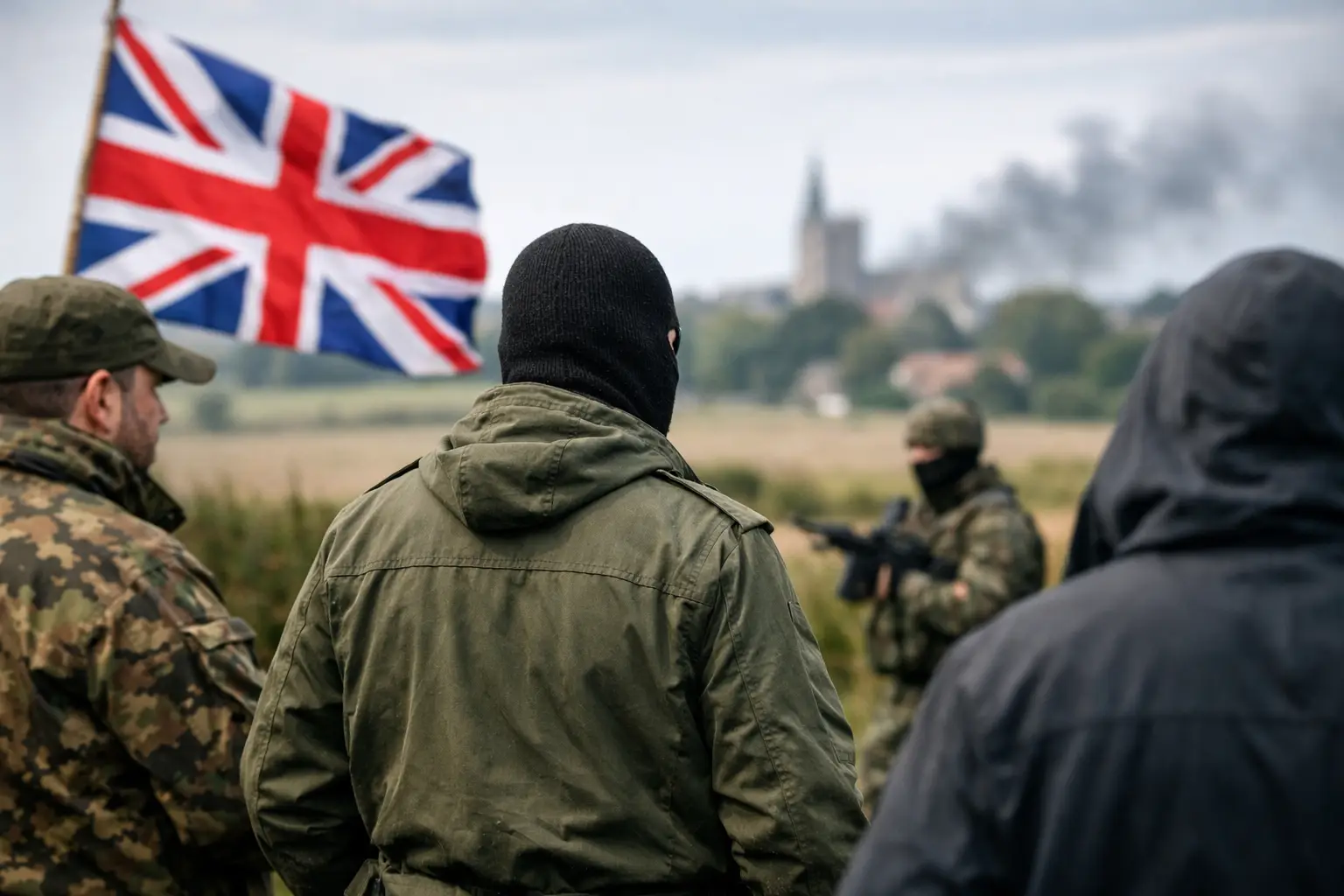
At 6.14am on a damp Tuesday, an A-frame sign appeared outside a village hall near Stowmarket bearing the words: “Suffolk Liberation Front – Members Please Wipe Boots.” By 8 o’clock, three people had asked whether it was a heritage open day, one thought it was a ukulele group, and a parish councillor described it as “deeply concerning, if only because the font was too confident”.
That, in many ways, is the Suffolk Liberation Front in a nutshell. It has the air of a movement, the discipline of a church jumble sale, and the political clarity of a man in a pub saying “someone ought to do something” before ordering another packet of dry roasted peanuts. Yet whispers persist. Who are they? What do they want? And why does every alleged communique sound like it was typed by an angry rides-on mower?
What the Suffolk Liberation Front actually stands for
Officially, nobody can quite agree. Unofficially, the Suffolk Liberation Front appears to be a loose coalition of mildly vexed residents, ceremonial traditionalists, anti-dual-carriageway romantics, and at least one retired deputy head who believes the county has been spiritually compromised by chain coffee and soulless roundabouts.
Their reported aims vary depending on which laminated notice you find blu-tacked to a bus shelter. Some demand the immediate restoration of “proper market town sovereignty”. Others insist that Suffolk must be liberated from over-signage, under-seasoned carveries, and the creeping influence of Essex day-trippers who say “let’s do Aldeburgh” as though it were a theme park. One particularly stern leaflet called for complete independence from “southern nonsense” and a return to local rule by people who know the difference between a village fete and a desperate branding exercise.
Naturally, critics have questioned whether the Suffolk Liberation Front is a serious political entity or simply six blokes, a labrador and a woman from Woodbridge with access to a laminator. That said, plenty of serious political entities begin in much the same way, only with worse biscuits.
The origin story nobody asked for
As with all important British movements, the alleged origins lie somewhere between a planning dispute and a misunderstanding at a community forum. Accounts differ, but most trace the birth of the Suffolk Liberation Front to a public consultation in which residents were invited to share their views on local development and instead spent two and a half hours complaining about parking, London second-home owners, and the disappearance of decent independent ironmongers.
By the end of the evening, one attendee is said to have stood up, adjusted his bodywarmer and declared, “If nobody else will defend Suffolk, we shall.” It was not clear from the minutes who “we” referred to. Nonetheless, the room reportedly fell silent, apart from someone at the back asking whether there would still be a raffle.
From there, the mythology took over. Secret meetings in pub function rooms. Encoded messages hidden in the classified ads. A map of East Anglia with arrows on it, which is always how these things begin when people want to feel historical. Before long, stories circulated of sleeper cells in Framlingham, strategic think tanks in Bury St Edmunds, and a tactical unit in Felixstowe whose main contribution seemed to be muttering about port traffic.
Why the Suffolk Liberation Front has caught on
The genius of the Suffolk Liberation Front, if that is not too grand a term for a campaign that once paused for a ploughman’s, is that it taps into a recognisable local mood. Not rage, exactly. Suffolk rarely does outright rage unless a tractor has been boxed in by tourists at harvest time. It is more a long, simmering suspicion that decisions affecting ordinary people are made elsewhere by people who describe villages as “assets” and think every field is just a delayed retail park.
That feeling is fertile ground for parody politics. The Suffolk Liberation Front speaks in the language of resistance, but its grievances are gloriously provincial. Not in a small-minded sense. In the best possible British sense, where the condition of a bypass, the closure of a bakery, or the rebranding of a pub into a gastropub called The Tiller & Finch can be treated as matters of civilisation itself.
There is also the small matter that modern politics has become so theatrical that a mock insurgency demanding fairer pricing in farm shops no longer feels wildly less plausible than half the things said on breakfast television. In that respect, the Suffolk Liberation Front is less an absurdity than a tidy administrative update on national decline.
Tactics, symbols and suspiciously polite militancy
If one were to judge the Suffolk Liberation Front by its symbolism, it is a movement committed to maximum confusion. Their supposed insignia has been described as a rampant red tractor on a cream background, though one eyewitness insists it was just an embroidered tea towel. There are rumours of code phrases, including “the barley is restless” and “this scone is political”, but neither has been independently verified.
Their tactics, meanwhile, suggest a revolutionary organisation that was raised to be considerate. Anonymous posters are placed squarely, never crooked. Threatening statements are proofread. One banner reading “No Justice, No Peace, Especially on the A14” was tied with such care that passing motorists assumed it was part of a National Trust event.
There have been alleged acts of disruption. A strategic rearrangement of artisan chutneys at a farm shop near Hadleigh. A flash occupation of a parish hall where insurgents reportedly issued a declaration on parking permits before stacking the chairs neatly and rinsing the mugs. Most dramatically, a source claims the group once infiltrated a district consultation dressed as ordinary residents, a disguise rendered imperfect only by the fact they were, in fact, ordinary residents.
The manifesto problem
Every movement eventually faces the burden of coherence, and here the Suffolk Liberation Front may have overreached. Draft manifestos have surfaced containing demands both stirring and impossible. These include county-wide priority status for tractors at junctions, an end to “performative prosecco culture”, mandatory pub carpets, stricter penalties for calling anything in Suffolk “basically Norfolk“, and a publicly funded taskforce to investigate why all new housing estates have the same haunted names.
Some of it is plainly unserious. Some of it, annoyingly, has broad support.
Is the Suffolk Liberation Front political or just fed up?
It depends who you ask. To supporters, the Suffolk Liberation Front is a corrective – a rejection of polished managerial language in favour of saying plainly that local life is being hollowed out by blandness, bureaucracy and people who think authenticity can be installed like patio doors. To sceptics, it is just rural grumbling in a theatrical waistcoat.
Both readings have merit. There is a long British tradition of wrapping genuine complaint in humour because it sounds less embarrassing than admitting one cares. If a resident says he has joined the Suffolk Liberation Front because the county has lost its soul, he risks sounding melodramatic. If he says he joined because village pubs now serve chips in miniature shopping trolleys, the room nods gravely.
That balancing act is what gives the whole thing its charge. The joke lands because the underlying irritation is real enough. Not armed struggle real, obviously. More “strongly worded letter and a muttered remark in the Co-op” real.
The Suffolk Liberation Front and the future of local absurdity
Perhaps the most likely future for the Suffolk Liberation Front is not insurrection but absorption into the normal rhythms of British civic life. A few more banners. A badly attended public meeting. A burst of local panic when somebody mistakes satire for policy. Then, before anyone quite notices, one or two of its sillier demands enter mainstream discussion because they were less silly than the alternatives.
That is often how these things go. The absurd frame allows people to say what they think without having to sound like they are auditioning for a party political broadcast. And if the Suffolk Liberation Front occasionally resembles a residents’ association that has inhaled too much county pride, it is still more vivid than the usual sludge of consultation jargon and strategic vision statements.
It would be rash to predict whether the movement will grow. Suffolk has a way of resisting grand narratives. It prefers anecdotes, local feuds, and practical complaints about mud. But if you spot another hand-drawn sign, another communique demanding dignity for market towns, or another mutinous gathering near a church hall where someone is passing round bourbons with revolutionary intent, do not dismiss it too quickly.
The Suffolk Liberation Front may not be coming for Westminster. It may barely be coming for Wickes. But in a county where even mild dissent can be delivered with a polite cough and a folded raffle ticket, that still counts as a rising. And if nothing else, it is a useful reminder that people will put up with almost anything except patronising redevelopment, weak tea, and the suggestion that Suffolk ought to be more like somewhere else.
If a movement can unite the county around those principles, however accidentally, it may yet achieve what most serious politics cannot – getting people to agree on something before the village hall heating packs in.