
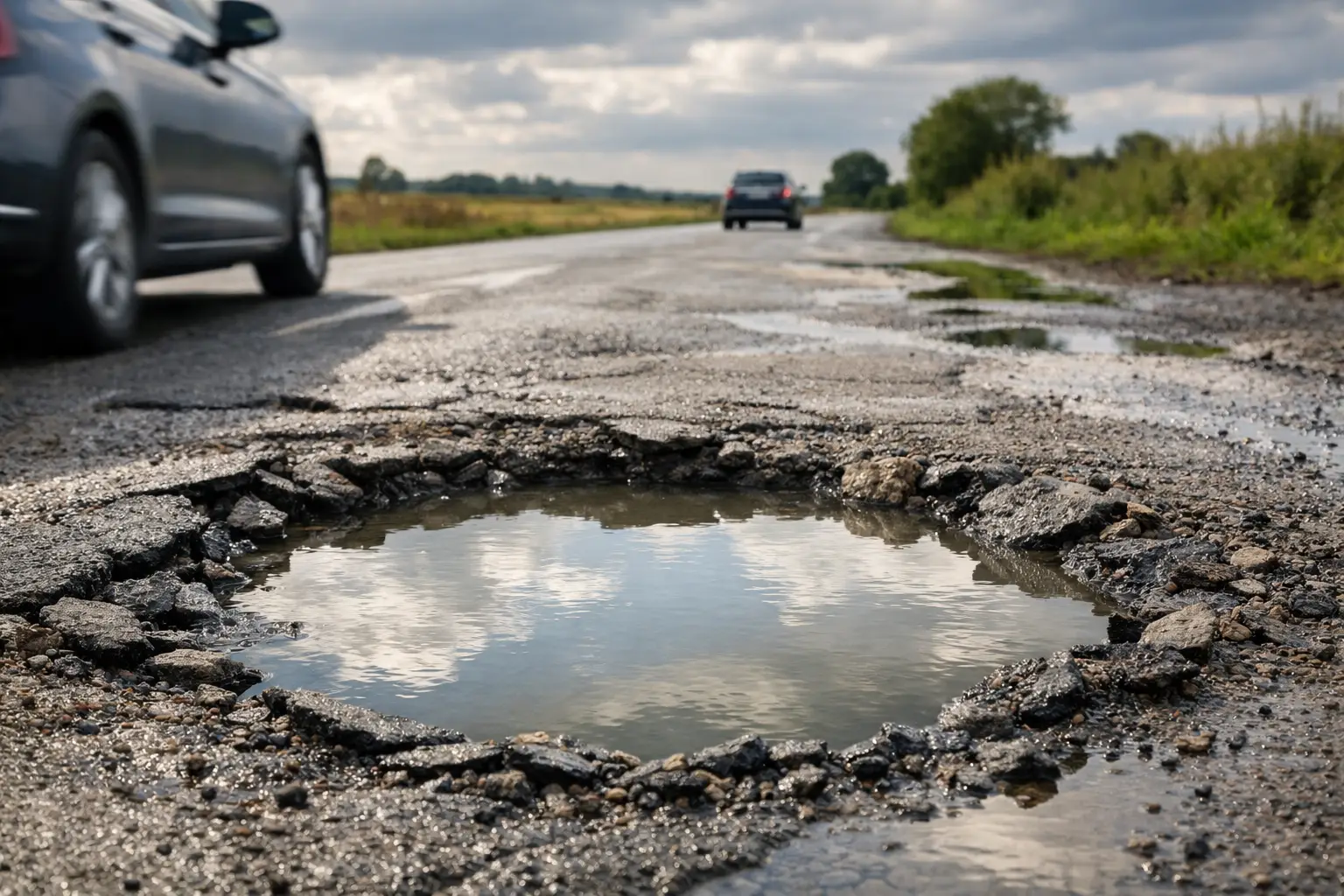
The first sign that potholes had gone too far came just outside Stowmarket, when a Vauxhall Corsa disappeared nose-first into what residents initially described as “a bit of a dip” and later, after measurements by a man from B&Q with a tape measure and opinions, as “basically the North Sea with white lines”. By mid-morning, three councillors, a bemused heron and a paddleboard instructor had all arrived at the scene, each convinced they had jurisdiction.
For years, motorists across Suffolk have complained about potholes with the weary resignation normally reserved for rail replacement buses, garden centre cafés and hearing the phrase “unprecedented demand” from somebody on a helpline. But local authorities now face a fresh challenge. These are no longer simple holes in the road. They are features. Landmarks. Destinations, even. One in Ipswich reportedly has a What3words location, two unofficial names and a TripAdvisor-style review reading, “Difficult approach but superb depth. Would sink alloy again.”
Why potholes now have local status
The old understanding of a pothole was comforting in its simplicity. Rain got in, cold weather froze it, the road cracked, a tyre burst, someone swore, and eventually a fluorescent jacket appeared to toss in a shovelful of steaming optimism. That neat cycle has broken down. Today’s potholes are bigger, moodier and frankly more politically aware.
In some parts of East Anglia, they have become so established that residents speak of them with the sort of possessive pride usually reserved for medieval churches and pubs with beams. In one Norfolk village, a parish newsletter referred to a long-standing crater near the bypass as “part of our shared heritage”, adding that while there were no immediate plans to repair it, bunting may be considered for summer.
There is also the visibility problem. A pothole used to be a passing annoyance. Now it arrives with force, rearranges a suspension system, and sends your shopping into the passenger footwell like a small-scale internal landslide. It demands to be noticed. It asks difficult questions of your tracking, your wheel alignment and your belief in representative democracy.
The politics of potholes
No issue in British public life inspires such a thrilling display of ceremonial concern. Faced with potholes, ministers promise action, councils announce funding, MPs visit roads in stout shoes, and local papers print photographs of men crouching beside holes while wearing expressions normally associated with war memorials.
The difficulty is that potholes occupy a rare position in civic debate. Everybody agrees they are bad, but nobody entirely agrees whose bad they are. Is it the county council, district council, Westminster, austerity, the weather, utility companies, cyclists, Europe, or Gary from down the road who keeps saying the Roman roads lasted longer? It depends who is within microphone range.
A senior source close to absolutely no one told reporters this week that a cross-party taskforce had been formed to tackle the issue, although critics noted this appeared to consist of four people in waterproofs looking into a hole and saying, “Blimey.” Still, in administrative terms, that counts as movement.
There is, of course, a trade-off. Filling every pothole would improve safety, reduce repair bills and calm the national mood by at least four per cent. But it would also remove one of the few remaining ways Britons can experience surprise. In an age of algorithms, pre-booked time slots and oat milk predictability, the pothole remains gloriously analogue. You don’t choose it. It chooses you.
Potholes and the British character
What makes potholes such a peculiarly British obsession is not just the damage. It is the etiquette around them. A proper pothole encounter unfolds according to strict national custom. First comes denial – that was probably nothing. Then anger – no, that was definitely something. Then the ceremonial pull-over, followed by the crouch, the tut, the inspection of tyre sidewalls, and finally the announcement to nobody in particular that “you couldn’t make it up”.
After that, the story enters circulation. Within hours, neighbours are discussing axle trauma over bins. Somebody posts a photograph online. A cousin in Lowestoft replies saying theirs is worse. An uncle in Bury St Edmunds claims he once hit one so hard the radio changed station out of respect.
This is where potholes differ from most infrastructure problems. A delayed planning application does not produce folklore. A blocked drain rarely becomes the centrepiece of a pub anecdote. But potholes generate narrative. They create heroes, usually tyre fitters, and villains, usually whichever level of government is least fashionable that week.
The economic miracle beneath your wheels
While critics focus on the negative side of potholes, some local entrepreneurs are taking a broader view. Independent garages have enjoyed what one mechanic called “a strong quarter in avoidable chaos”. Wheel alignment specialists are reportedly thriving. A man in Felixstowe has begun offering guided 4×4 experiences through a retail park access road, promising “all the drama of off-roading without the inconvenience of scenery”.
Then there is tourism. It may sound fanciful, but so did farm shops thirty years ago. If a village can monetise a scarecrow festival and a market town can run an entire weekend around sausage appreciation, it is only sensible to ask whether potholes might finally deliver the regional growth politicians keep mentioning with straight faces.
One proposal under quiet discussion would see notable road cavities graded like listed buildings. Particularly dramatic specimens could receive interpretive plaques, small viewing barriers and, where depth allows, a life ring. Opponents say this sends the wrong message. Supporters argue the message has already been sent repeatedly through their suspension.
Can potholes actually be fixed?
Technically, yes. Spiritually, the nation seems less certain.
Repairing potholes sounds simple until you meet the realities of budget cycles, contractor availability, weather windows and the mysterious tendency for a freshly repaired surface to resemble a school science project by Tuesday. Temporary patching is quick but often brief. Full resurfacing lasts longer but costs more and requires closing roads, which leads to a second British hobby: complaining about roadworks.
So councils face the classic no-win scenario. Leave the potholes alone and drivers revolt. Fix them badly and drivers revolt with evidence. Fix them properly and drivers revolt because there are cones outside a roundabout for six days. Public service, in this context, is largely the management of mutually incompatible expectations.
That is why some residents have moved beyond complaint into adaptation. Delivery drivers now swap crater intel with the urgency of wartime codebreakers. Parents on the school run develop slalom reflexes that would impress professional skiers. Taxi passengers in Suffolk have learnt to hold tea, dignity and lower back in a single tense manoeuvre.
The future of potholes
Experts in transport, weather and staring gravely at maps agree that the problem is unlikely to vanish soon. More rain, older roads, heavier vehicles and years of patch-and-pray maintenance all point in one direction – down, abruptly, with a loud bang from the near-side front.
Still, Britain excels at carrying on. If national renewal never quite arrives, national coping certainly does. There is already talk of smart cars that detect potholes in advance, though cynics point out the only truly reliable warning system remains the driver in front swerving like he has spotted an escaped goose.
It may be that we are asking the wrong question. Instead of demanding when potholes will disappear, perhaps we should ask what sort of relationship we now have with them. Hostile? Certainly. Co-dependent? Quite possibly. Familiar to the point of Stockholm syndrome? Ask anyone who says, with genuine affection, “Mind the one by the Co-op, it’s deep after rain.”
In the end, potholes endure because they sit at the perfect crossroads of British life – bad weather, stretched services, municipal theatre, private grumbling and the deep, unshakeable belief that somebody ought to sort it out, preferably by Thursday. Until then, drive carefully, keep both hands on the wheel, and if the road ahead appears to contain its own weather system, it may be wise to go round.