
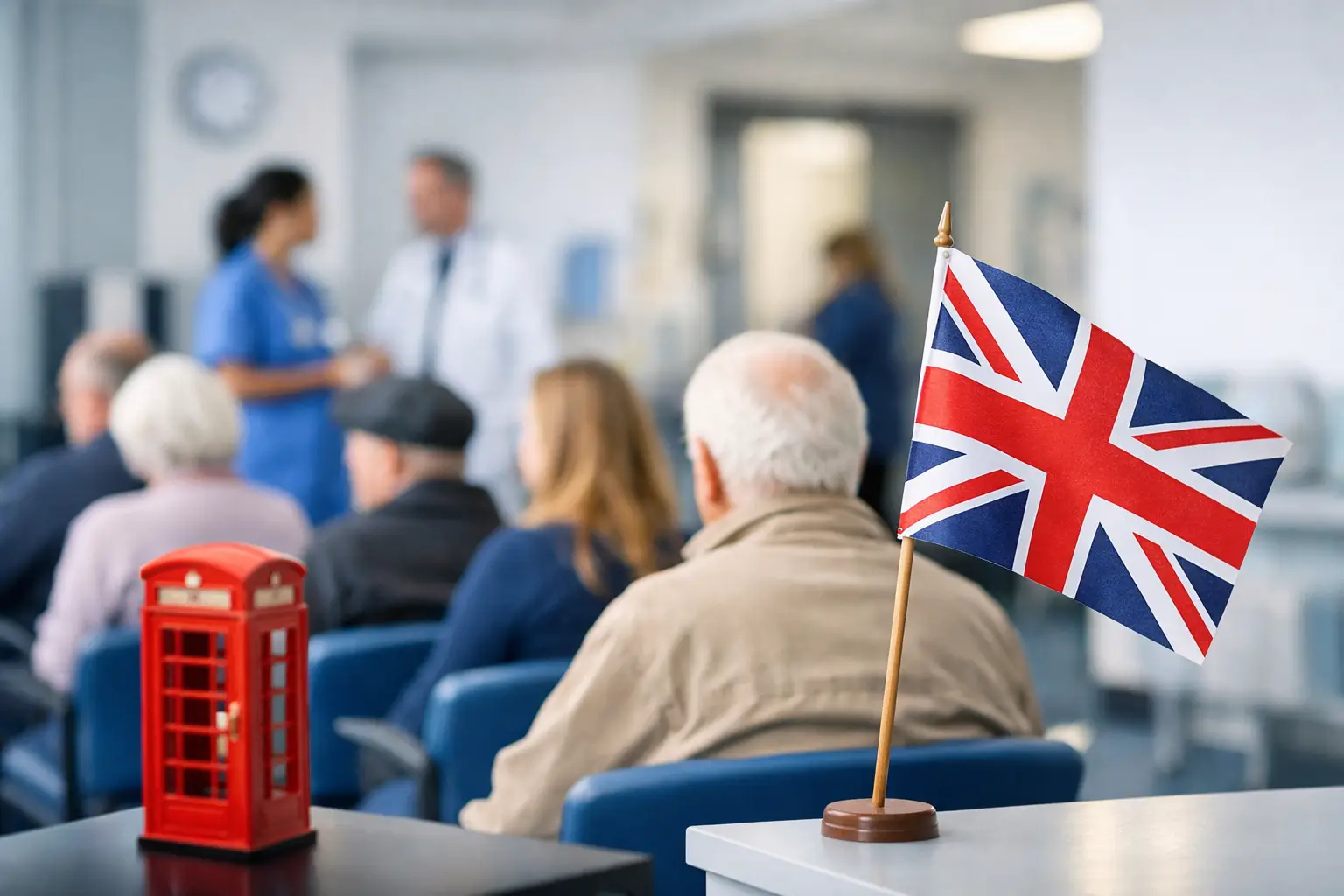
A man from Bury St Edmunds says he joined the NHS waiting lists shortly after the London Olympics and now regards them as “more of a lifestyle commitment than a medical pathway”.
By Our Political Correspondent: Polly Ticks
Speaking from a folding chair he brought to an outpatient department in 2017 and has refused to leave ever since, he told reporters he has “made peace with the process” and now receives birthday cards from three receptionists, a vending machine engineer, and what he believes may be a ghost in Facilities.
Health officials, in the tone usually reserved for flood warnings and rail replacement bus services, have insisted that pressure on services remains “challenging”. Patients, by contrast, have begun using more technical language such as “absolutely ridiculous”, “how is this still happening”, and the ever-reliable “it’s one rule for them”.
Why NHS waiting lists now qualify as a national pastime
There was a time when queues in Britain meant something dignified: a shop opening, a ferry to France, perhaps a Gregg’s with one member of staff and a nation’s worth of lunchtime regret. But NHS waiting lists have evolved beyond ordinary queueing. They are now a form of civic participation, like voting or pretending to understand the offside rule.
In Suffolk and Norfolk, where local stoicism remains stronger than mobile signal, residents have reportedly taken to preparing for referrals the way previous generations prepared for winter. Households are said to be laying in supplies, charging power banks, and selecting a “good cardigan for consultants”. One family in Lowestoft has allegedly drawn up a five-year rota for who will ring the hospital, who will sigh meaningfully, and who will say “we do understand they’re under pressure” before quietly losing the will to continue.
This is, of course, where the genius of British bureaucracy reveals itself. No system on earth can make people simultaneously furious, apologetic and faintly guilty for existing quite like this one. You can be in pain, waiting months for a letter, and still feel bad for asking where the letter is. It is an administrative miracle, if not a clinical one.
The official response to NHS waiting lists
Authorities have unveiled the traditional package of measures, including fresh targets, stern language, and a laminated chart somewhere. A spokesperson described the situation as “a priority”, which in government dialect broadly means someone has used a yellow highlighter on it.
Hospitals are said to be tackling backlogs with a blend of innovation and ritual theatre. New initiatives reportedly include triage by horoscope, consultants appearing briefly in village halls, and one pilot scheme in Ipswich where patients can move up the queue by proving they know what PALS stands for without sounding sarcastic. Early data suggests no one can.
There is, to be fair, a trade-off that even satirists have to admit. Demand is high, staffing is stretched, estates are ageing, and every winter arrives with the air of a sequel no one asked for. The problem with NHS waiting lists is not that there is one simple villain twirling a moustache beside a broken MRI scanner. It is that Britain has spent years building a healthcare system expected to function flawlessly while held together by overstretched staff, goodwill, and the nation’s deep emotional attachment to saying “mustn’t grumble”.
That said, it does become harder to maintain perspective when your first referral was made on a fax machine and your follow-up text arrives asking you to rate the experience out of ten.
Patients adapting to life on the list
As with any prolonged national event, people have started to adjust. Local support groups now reportedly help first-time waiters settle in. Sessions cover the basics: how to interpret a letter that says almost nothing, how to remain calm when an appointment is moved from Thursday to a concept, and whether bringing a flask counts as preparedness or surrender.
One woman from Sudbury says the waiting changed her as a person. “At first I was angry,” she said. “Then I became philosophical. Now I can identify the exact species of mould in hospital ceiling tiles and I’ve accepted that time itself is an administrative opinion.” Friends say she has become respected in the community and may soon chair a parish subcommittee on delayed correspondence.
In some areas, patients on the same pathway have formed surprisingly close bonds. One orthopaedics group in Norfolk is believed to have held two weddings, a christening and a strongly attended quiz night while waiting for updates. Team names included Scan Me Maybe, Meniscus to Society and The Unbearable Tightness of Being. Organisers said morale was high despite concerns the grand prize hamper might be clinically indicated.
What the experts say, or at least what they say on local radio
Analysts continue to debate whether the current state of affairs is a temporary bulge, a structural crisis, or simply the final form of the British state. One school of thought argues that recovery requires investment, workforce planning and realistic capacity. Another suggests turning every empty retail unit into a diagnostic hub and seeing whether any former Wilko can support minor surgery.
It depends, as these things often do, on whether leaders want headlines or outcomes. Announcing a plan is quick. Training staff, replacing kit and fixing the plumbing takes longer and has the fatal disadvantage of being real. The public can tell the difference, even if they remain far too polite about it.
There are also regional quirks. Rural counties face longer travel times, patchier transport and the sort of local roadworks that appear to have hereditary titles. If your treatment pathway involves two buses, a lift from your cousin Darren and crossing an A-road that was clearly designed by someone with a grudge, access becomes its own waiting list.
A breakthrough in queue management
In a development being hailed by nobody sensible, an unnamed trust has reportedly tested a new approach in which patients are informed of their likely waiting time using the familiar language of takeaway apps. Cases are labelled with updates such as “consultant is preparing your order”, “your referral has been delayed by traffic” and “you are number 84 in the queue, but remain very important to us”.
Meanwhile, a village near Framlingham claims to have solved the problem entirely by appointing one retired headmistress to stand outside the hospital and sort everyone into sensible lines. Witnesses say waiting times immediately fell, tempers cooled, and one junior administrator burst into tears after hearing the phrase “come along now, this won’t do” delivered with proper East Anglian authority.
Policy thinkers are expected to ignore this finding because it does not involve a dashboard.
The strange emotional weather around NHS waiting lists
What makes the whole business peculiarly British is not simply the delay. Plenty of countries have shortages, backlogs and systems under strain. What we bring to it is ceremony. We add etiquette. We turn practical frustration into an elaborate dance of apology, understatement and muttering in car parks.
People do not merely endure the wait. They narrate it. They compare referral dates the way older generations compared mortgage rates. They develop folklore around departments, rumours about mythical cancellation slots, and firm views on which receptionist “actually gets things done”. Entire social ecosystems now depend on one person knowing someone whose neighbour once got seen early in Cambridge because of a form no one else has heard of.
Even the language is revealing. Nobody says, “I have been abandoned by an overloaded system shaped by years of political caution and operational strain.” They say, “I’m still waiting, actually,” with the haunted brightness of someone who has already made tea for the district nurse in their imagination.
And yet, for all the jokes, people still care deeply because the NHS still matters deeply. That is the awkward truth sitting underneath the punchlines. People complain because they want it to work, not because they want to see it fail. Staff are not the butt of the joke here. The joke is the national habit of asking exhausted people to perform miracles while ministers unveil another slogan and the photocopier emits the sound of constitutional decline.
If there is any hope in all this, it lies in honesty. Not the theatrical sort, with a podium and a borrowed hard hat, but the kind that admits what capacity exists, what it would take to improve it, and how long that really means. Britons can cope with bad news. We’ve managed drizzle, service stations and James Corden. What we struggle with is being told a queue is moving when we can still see the same biscuit wrapper on the same waiting room floor six months later.
So if you are currently on NHS waiting lists, take heart. Not in the official sense, as that may require referral, but in the broader human one. Bring a book. Charge your mobile phone. Be kind to the staff. And if a retired headmistress offers to organise things, stand back and let Britain heal.