
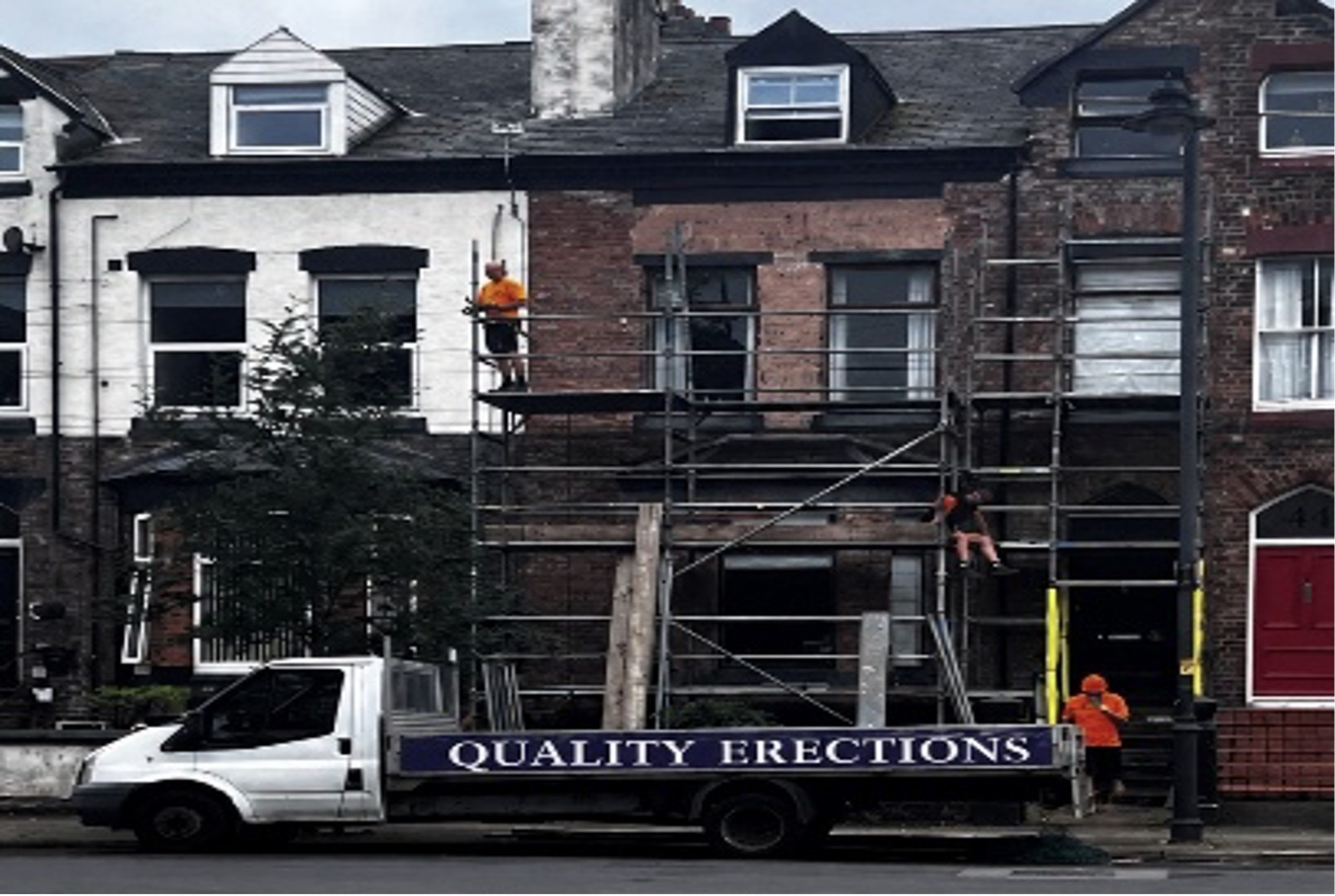
The local construction & scaffolding firm’s suggestive name floods the receptionist with misdirected phone calls.
By Our Property Correspondent: Ruth Tyler
LOWESTOFT — A local scaffolding firm has experienced an unprecedented surge in inbound customer enquiries following a mobile branding campaign that has caused excitement amongst female residents.
The firm, operating under the corporate title “Quality Erections”, has been highly visible throughout the Lowestoft area this week. Labourers have been observed deploying industrial scaffolding poles and wooden planks onto local commercial and residential properties, retrieving the parts from a flatbed truck that features the company name emblazoned in large, high-visibility lettering across its side panels.
While the company name accurately describes the structural integrity of the steel frameworks being assembled, the public interpretation of the signage has proven heavily decoupled from the construction industry.
Galvanized steel towers
According to the company’s central reception desk, the commercial vehicle’s daily transit through residential neighbourhoods has triggered a substantial volume of telephone traffic. A significant percentage of the calls originate from lonely housewives within the Suffolk coastal strip, many of whom appear to have fundamentally misunderstood the precise nature of the services on offer.
“The phone has not stopped ringing, but very few people actually require their chimneys repointed,” stated company receptionist Brenda Cooper, 54. “I spent forty minutes this morning explaining to a woman in Oulton Broad that we do not offer domestic home visits of a therapeutic nature and that our standard rate is strictly for two-tier galvanised steel towers.”
Despite the operational friction caused by the influx of non-commercial enquiries, management has declined to initiate a corporate rebranding strategy. A spokesperson for Quality Erections confirmed that the company’s signage remains fully compliant with transport advertising regulations, noting that any alternative interpretation of their structural services is entirely a matter for the consumer’s imagination.