
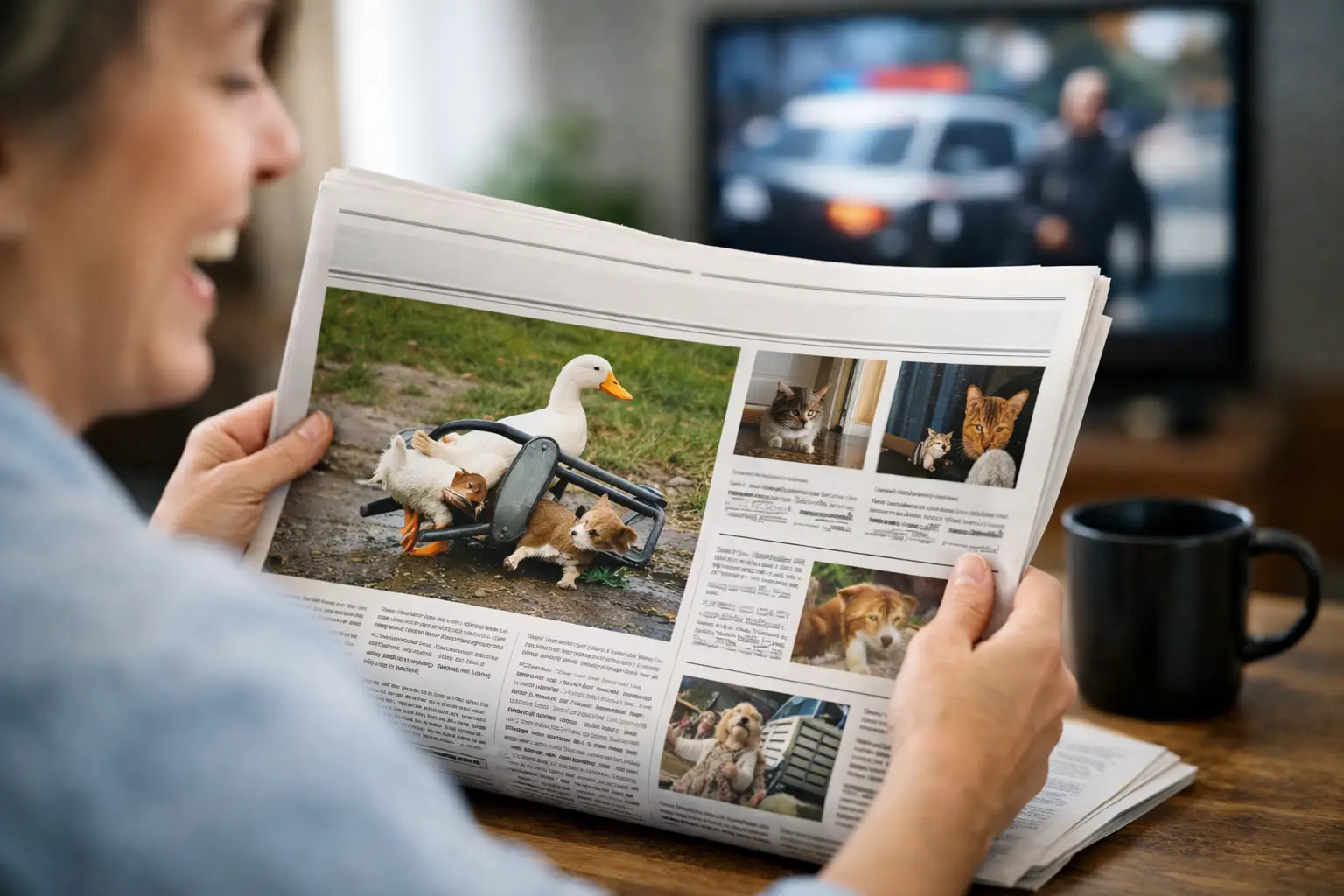
A man in a market town complains to the council about an aggressive swan. A parish meeting descends into open warfare over a commemorative bench. A garden gnome is reported missing with the solemn urgency usually reserved for a cabinet resignation. Funny local newspaper stories thrive in exactly this territory – the bit where public life, petty grievance and accidental theatre all meet under a headline written with absolute sincerity.
That is why they travel so well. They look small, but they carry a lot. A proper local oddity is never just about a rogue peacock in a Co-op car park. It is about British officialdom trying to maintain dignity while the universe, as ever, has other plans. The genius of the format is that it treats the trivial as historic and the absurd as routine. Readers know the pose. They have seen the town hall quotes, the outraged neighbour, the grainy photo, the line from police urging calm. The joke lands because the shape is already familiar.
What funny local newspaper stories get right
The best funny local newspaper stories understand that comedy lives in contrast. You need the grave tone of a council statement describing something fundamentally ridiculous. You need a quote from a resident called Barry, 68, who speaks as if the hanging basket dispute marks the collapse of civilisation. And ideally you need a place name that sounds invented but regrettably is not.
Local news has always had a strange gift for scale. A broken bus shelter can be framed like a national emergency. A scarecrow competition can receive coverage more forensic than a Treasury leak. Satire works brilliantly in that space because it barely has to force the joke. It simply nudges reality half an inch further and lets the form do the rest.
That is also why made-up regional stories often feel truer than earnest commentary. Bureaucracy is inherently funny because it insists on procedure even when faced with nonsense. British life adds another layer – committees, notices, parish rows, passive aggression, village Facebook groups and the sort of public complaint that begins, “I am not being funny, but…” before becoming very funny indeed.
The anatomy of a local story that gets shared
A shareable story usually begins with a headline that sounds just plausible enough. Not so mad that it becomes fantasy at first glance, and not so ordinary that nobody clicks. There is an art to the deadpan claim. “Town furious as duck ignores pedestrian crossing” works because it borrows the language of civic outrage and applies it to a duck, which has never in its life respected signage.
Then comes the setting. Hyperlocal detail matters. Not generic “a village” but the kind of place where everyone can instantly picture the church hall, the slightly damp carpet in the function room, and the man who still calls the bypass “the new road” twenty years after it opened. The more specific the setting, the bigger the laugh. A ridiculous thing happening in a recognisable place always beats a vague joke floating in nowhere.
Characters matter too. Local newspaper comedy depends on authority figures trying to keep a straight face while events refuse to cooperate. Council leaders, station masters, vicars, pub landlords and “concerned residents” all carry comic potential because their titles suggest order. Their circumstances rarely do.
And finally, there is escalation. Not too quickly. The funniest pieces begin with a minor issue and then let it swell into ludicrous seriousness. A noise complaint becomes a heritage dispute. A missing wheelie bin becomes a matter for three agencies, a local petition and one retired colonel writing to the paper in all capitals. That slow inflation is where the British comic instinct really earns its keep.
Why the British love local absurdity
Part of the appeal is classically national: we adore understatement until we suddenly do not. We spend days pretending a bizarre public situation is perfectly manageable, then hold a meeting about it in a draughty hall with instant coffee and visible resentment. Funny local newspaper stories bottle that rhythm perfectly.
They also flatter the reader. To enjoy the joke properly, you need to understand the codes. You need to know why a district council press release is funny before anyone has added a punchline. You need to appreciate the menace of the phrase “residents have raised concerns”. You need some affection for market towns, dual carriageways, village fetes, chip shops, bus routes and civic projects unveiled by a man with oversized scissors.
That is why regional satire often lands harder than broad political gags. It rewards recognition. If you have ever stood in a queue at a post office while somebody attempts to report a parking issue, you are already halfway to the joke. If you have ever seen a local paper give six paragraphs to a runaway pig, you understand the form at a cellular level.
Why parody versions feel so convincing
Parody works best when it respects the machinery of journalism. The headline has to snap. The opening line has to state the lunacy with complete confidence. The quotes must sound as if they came from someone who has mistaken personal irritation for national significance. Even the categories help – news, sport, business, farming, obituaries. There is something deeply funny about placing total silliness inside the same sturdy framework used for road closures and council tax changes.
This is where publications such as Suffolk Gazette have a natural advantage. The joke is not just the absurd event. It is the immaculate performance of local news itself – the tone, the structure, the earnestness, the little flicker of authority that makes the madness sparkle. Readers are not only laughing at the premise. They are laughing at the entire ceremonial dance of how Britain reports things.
There is a trade-off, though. If a parody is too broad, it loses local flavour and becomes just another gag. If it is too niche, half the country misses the point. The sweet spot is a story rooted in place but built on emotions everyone knows: irritation, pride, nosiness, pettiness, jobsworthery, and the eternal hope that somebody else will deal with it.
The secret ingredient is affection
Pure sneering rarely works in this format. Funny local newspaper stories are sharp, but they cannot despise their own world. The best ones laugh at communities while clearly belonging to them. They know the village idiot is often also the pub quiz host and a valued source of scaffolding recommendations. They understand that the woman leading the outrage over the flower display might also be right, in her own terrifying way.
That affection keeps the joke buoyant. Without it, satire becomes smug. With it, even the most absurd line feels like an inside joke shared across a county boundary, a supermarket aisle or a comments section full of men named Keith demanding action.
It also explains why readers share these pieces so readily. Sending someone a story about Westminster can feel like homework. Sending them a mock report about a town declaring war on a pothole feels like a gift. It says, “This is ridiculous, but also suspiciously close to how things actually work.” That mixture of escapism and recognition is powerful.
What makes a bad local news joke
Usually, it tries too hard. If every sentence winks, the spell breaks. The local newspaper style depends on restraint. A straight face is doing most of the labour. The writing should sound as if it believes every word, even while describing a fete marred by a goose with leadership ambitions.
Bad examples also skip the texture of ordinary life. They forget the mundane details that make silliness feel real: laminated notices, folding chairs, traffic cones, half-heard complaints, weather ruining everything at the key moment. British absurdity is rarely glamorous. It happens in leisure centres, on roundabouts, in parish newsletters and outside Greggs.
And some stories simply go too big. A minor row over bunting is funnier than an alien invasion over Bury St Edmunds High Street. One sounds exactly like the sort of thing that would spiral on local radio for three days. The other belongs elsewhere.
Why these stories will never go out of fashion
Because the raw material is eternal. There will always be overzealous officials, territorial birds, baffling signage, neighbour disputes and public consultations attended by one furious man and a biscuit plate. There will always be communities trying to preserve dignity while living through scenes no script editor would dare pitch straight.
As news gets louder, funnier local newspaper stories offer something oddly comforting. They reduce the world to a manageable scale. Here is one ridiculous incident. Here is one street, one pub, one memorial bench, one man in a hi-vis jacket taking things much too seriously. The stakes are gloriously low, yet the emotions are recognisably huge.
And that may be their real value. They remind us that public life is not only ideology and crisis. It is also a parish noticeboard, a muddled quote, a row over ducks, and a community trying to narrate its own nonsense with a straight face. If you want a better joke, do not look away from local life. Read it more closely. It has been writing punchlines for years.