
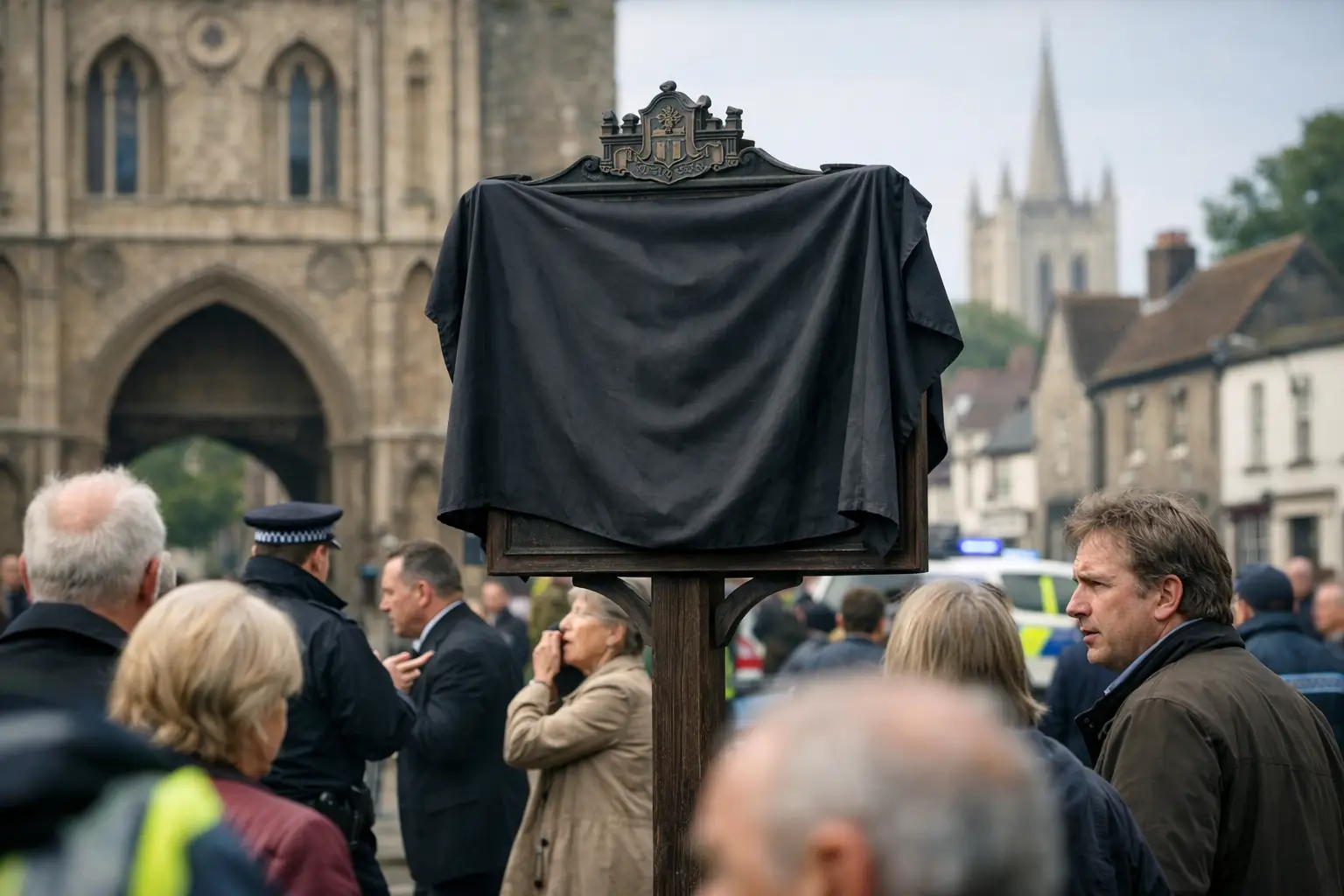
By 8.14am, the bury st edmunds sign board outside the town centre had already done what years of consultation, branding exercises and laminated council vision statements could not – it had united Bury in bafflement.
By Our Angling Correspondent: Courtney Pike
Commuters slowed. Dog walkers stopped. One man on his way to buy a sensible bacon roll from Greggs reportedly muttered, “That can’t be right,” before immediately photographing it for the family WhatsApp and three separate local Facebook groups. The electronic sign, normally reserved for worthy notices about market days, temporary roadworks and vaguely threatening reminders about considerate parking, had instead displayed a message so startlingly confident and so completely unhelpful that residents assumed, quite reasonably, that it must be official.
The message, according to witnesses, read: “WELCOME TO BURY ST EDMUNDS – PLEASE PROCEED AS IF YOU KNOW WHAT YOU’RE DOING.”
That was enough. Within minutes, the town had split into the sort of factions usually only seen when someone proposes changing the one-way system or moving a bin.
Why the Bury St Edmunds sign board matters more than it should
On paper, a sign is just a sign. It tells you where you are, what to avoid, and occasionally which local dignitary has opened a flower bed. In practice, a town sign board is something much grander. It is civic theatre in aluminium form.
Bury St Edmunds understands this instinctively. This is a place that likes its heritage tidy, its market square photogenic and its public messaging wrapped in a tone of gentle authority. So when the sign board decided – or was alleged to have decided – to sound like a sixth-form philosophy student left alone with a council password, people took it personally.
One retired resident described the incident as “a collapse in municipal standards”. A younger onlooker called it “the funniest thing the council’s done in years, even if by accident”. Both views can be true, which is often the sweet spot for local government.
The council, naturally, moved quickly to say almost nothing. An early statement praised “the public’s continued engagement with wayfinding infrastructure” which is exactly the sort of sentence produced when nobody wishes to admit Derek from Facilities may have pressed the wrong button while trying to update a notice about hanging baskets.
Competing theories emerge
No local drama is complete without wild speculation dressed up as concern. By lunchtime, Bury had produced enough theories to sustain an entire season of regional current affairs programming.
The first and most boring explanation was human error. Perhaps a staff member had been testing the display and forgotten to delete a draft message written in a moment of private honesty. This was dismissed by several residents on the grounds that nobody employed by the council would ever write anything so direct.
The second theory blamed hackers. Not the glamorous sort from cinema, obviously, but the more realistic parish-level kind – a man in a fleece somewhere near Diss with a grievance about parking permits and an above-average understanding of municipal software. This theory gained traction because it allowed everyone to sound modern while understanding none of the details.
Then came the preferred local explanation: that the sign had become sentient after years of exposure to contradictory traffic orders, Christmas light schedules and information about artisan sausage festivals. Under this theory, the board had simply cracked and started telling the truth.
Frankly, it is the strongest of the three.
A sign board becomes a movement
By mid-afternoon, the phrase “Please proceed as if you know what you’re doing” had escaped the physical sign and entered the bloodstream of the town. A café allegedly chalked it up beside the soup of the day. A parent was heard saying it to a Year 9 child carrying a clarinet. At least one office worker changed their email status to it and received, for the first time in months, a message of sincere appreciation from colleagues.
This is the thing about accidental slogans. The official ones are usually assembled in committee until every interesting edge has been sanded away. They promise vibrancy, growth and opportunity, all while sounding like they were generated by a photocopier having an emotional crisis. But a rogue message with a bit of nerve cuts through instantly.
Bury, after all, is not a place short of confidence. It’s a town that can do abbey ruins, pints and polite superiority all before lunch. Yet there is also something deeply British, and specifically East Anglian, in being gently nudged through daily life by signage that amounts to: we trust you, but only just.
The high street reacts with measured hysteria
Shopkeepers were among the first to understand the moment. One market trader reportedly said the message was “the clearest civic guidance we’ve had since 2004”. A barber suggested it should replace all motivational art in local businesses. Two pubs are believed to be considering it for tea towels.
Not everyone was charmed. A small but committed bloc argued that the sign board had undermined the dignity of the town. They worried visitors might think Bury St Edmunds unserious, which would come as a severe blow to any place containing both medieval architecture and at least one man who says “actually” before every sentence in the wine aisle of Waitrose.
Still, there are trade-offs. If a town wants to attract attention online, it can spend months paying consultants to produce a strategy document full of words like destination and experience. Or it can allow one wayward sign board to tell the public exactly what every rail replacement bus has been implying for years.
What makes a Bury St Edmunds sign board believable
The genius of the whole affair is that people believed it at once. Not because it was polished, but because it felt emotionally accurate. That is always the mark of strong public messaging, even accidental public messaging.
Residents know the town is lovely. They also know it can be faintly bewildering if you arrive at the wrong time, use the wrong car park or attempt to navigate a road layout designed, it seems, by a committee of hedgehogs. So a sign that greets newcomers with mild doubt is not satire from nowhere. It is local realism with better timing.
There is also the matter of tone. British people, especially in places with a healthy respect for understatement, will accept almost anything if it is delivered deadpan and mounted on official-looking infrastructure. Put nonsense on a billboard in fluorescent lettering and people object. Put it on a council sign in sober capitals and someone starts a petition to preserve it.
The council considers next steps, sadly
Sources close to the matter – meaning a man outside the post office who claimed to know somebody in the building – say officials are now considering a full review of digital signage protocol. This is exactly the kind of phrase that causes ordinary taxpayers to stare at the horizon and wonder whether Rome had these problems.
Among the options reportedly being discussed are tighter password procedures, a clearer approvals process and the appointment of a temporary Signage Integrity Lead, which sounds made up but so does half of local administration once written down.
There is even muttering about replacing the board entirely. This would be a mistake. You do not punish a sign for briefly showing more personality than an entire regeneration brochure. You give it a small civic medal and perhaps a warmer font.
If anything, the episode has offered Bury St Edmunds a rare branding opportunity that did not involve consultants, bunting or somebody saying the word stakeholders six times before elevenses. It gave the town a line people actually want to repeat.
Could the sign stay?
It depends how brave everyone feels once the fuss settles. Officialdom tends to prefer messages that cannot be laughed at, which is unfortunate because those are usually the ones nobody remembers. Yet towns are remembered for odd details, not strategic plans. A crooked sign. A strange statue. A message board that accidentally nails the national mood before breakfast.
If Bury had any sense, it would keep the line, claim it was intentional and unveil it with a modest ceremony involving local press, one disappointed mayor and a ribbon that refuses to cut first time. There would be outrage, naturally. Then mugs. Then tote bags. Then broad acceptance.
And in a month’s time, half the county would be quoting it every time they attempted a self-checkout, joined the A14, or opened a letter marked “important information enclosed”.
That, in its own way, is public service.
For now, the sign has reportedly returned to more conventional messages, urging caution, patience and awareness of upcoming traffic management. Fine. Necessary, even. But a little flat. Once you’ve seen a glimpse of administrative honesty, it is hard to get excited about delays near the roundabout.
Still, Bury St Edmunds has learned something useful here. The town does not need louder branding. It needs sharper jokes, straighter faces and perhaps slightly fewer people with access to display settings.
If the board flickers back into life tomorrow with another pearl of municipal wisdom, residents should resist complaining and simply do as instructed – proceed as if they know what they’re doing.