
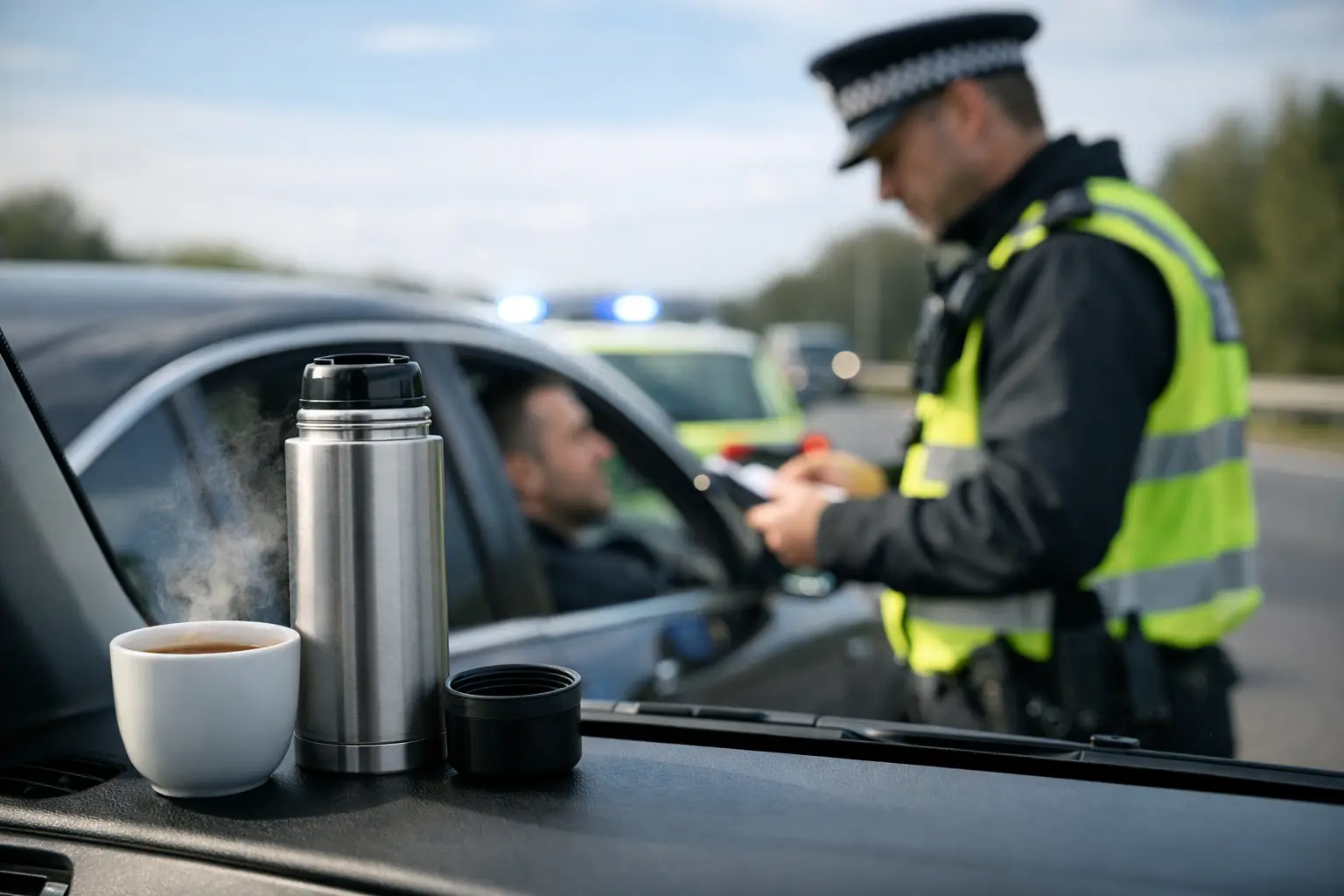
Motorists have been warned that the alleged new highway code rules uk: driving without a flask of tea now triggers automatic £500 fine are entirely made up, much like a council consultation that ends before anyone has found the attachment. Still, that has not stopped drivers across Suffolk from panic-buying tartan Thermos flasks and asking whether builder’s tea counts if it was brewed in Cambridgeshire.
The fictional measure, said to have been introduced at 00:01 on a wet Tuesday for maximum administrative menace, would require every vehicle to carry a “roadworthy beverage vessel” containing no fewer than 400ml of tea at a drinkable-but-not-litigiously-hot temperature.
Officials in this invented world insist the rule is about safety. A motorist without tea, they say, is only three miles from becoming “tired, peckish and emotionally vulnerable to a service-station sausage roll”.
New Highway Code tea-flask rule causes panic at lay-bys
The imaginary £500 penalty would be issued automatically by cameras capable of detecting an empty cup holder from 400 yards away, even in rain, fog and the sort of bright low sun that makes every A-road journey feel like a hostage situation.
The cameras are reportedly being tested near Bury St Edmunds, where they have already mistaken 17 gravy boats, a child’s science project and one man’s decorative urn for non-compliant tea flasks. A further six drivers were flagged after carrying coffee, which the system categorised as “an aggravating lifestyle choice”.
Under the fake guidance, drivers stopped by police would be asked to present their flask, state its contents and name the biscuit they would ideally have alongside it. Those answering “anything gluten-free” would be referred to a specialist officer for further questioning.
A spokesperson for the completely nonexistent Department for Transport Beverage Compliance Unit said: “We are not anti-coffee. We simply believe that anyone attempting the A14 at 4.30pm without a strong tea and a vague feeling of resignation is taking unnecessary risks.”
They added that herbal infusions would be accepted only if accompanied by a convincing explanation and an apology to the nation.
What drivers would need to carry
The fictional regulations are exceptionally precise, because no British rule is considered fully operational until it has made a perfectly normal activity faintly embarrassing. Motorists would need a flask with a screw-top lid, an internal temperature of between “quite warm” and “don’t be daft”, plus at least one emergency tea bag taped somewhere within reach of the handbrake.
Loose-leaf tea is permitted, although drivers choosing it must allow an additional 20 minutes for the inevitable conversation about it. Decaffeinated tea is technically legal but would place the motorist on a voluntary register monitored by a man called Colin in an office above a vape shop in Ipswich.
There would also be exemptions. Taxi drivers could carry a paper cup from a petrol station, provided the lid was stained with old sugar and the cup had spent at least half an hour rolling beneath the passenger seat. Farmers travelling in tractors would be allowed a flask of any size, including one apparently designed to serve a village fete. Owners of classic cars could substitute a picnic hamper, as long as it contains a Victoria sponge and a tool whose purpose nobody can identify.
Electric vehicle drivers, meanwhile, would be encouraged to recharge themselves while their car charges, creating the nation’s first official 47-minute tea break at a retail park outside Thetford.
The evidence, apparently
In a document that definitely does not exist, researchers claimed a proper flask improves concentration by 62 per cent, patience in queues by 81 per cent and the likelihood of allowing someone out of a side road by “a measurable amount, provided they wave”.
The study also found that drivers who had forgotten their tea were more likely to make dangerous decisions, including buying a £4.79 latte at a motorway services and saying “it’s actually not bad”.
One anonymous road-safety expert, who may have been a man overheard in a Felixstowe café, said the science was obvious. “A hot drink gives people something to do while they sit in a queue caused by roadworks that have been there since the coalition government. It’s public health, really.”
Suffolk reacts with the usual restraint
The news has prompted scenes of calm, rational debate in village Facebook groups, meaning 900 comments posted before breakfast. Some residents demanded an immediate return to common sense, while others insisted the fine should be increased to £1,000 for anybody carrying fruit tea “on a weekday”.
At a petrol station near Stowmarket, a queue formed at 6am after rumours spread that flasks were being rationed. By 6.12am, the shop had sold out of travel mugs, two packs of Hobnobs and every copy of a motoring magazine featuring a man polishing an Austin Healey.
Local dad Martin P., 48, said he had fitted cup holders to all three family cars, his lawnmower and “the little wagon thing we take to bonfire night”. He told reporters: “You can’t be too careful. Last time the rules changed I spent £90 on a first-aid kit and then discovered it was just the school asking for plasters.”
His wife, Karen, said the family’s greatest concern was not the £500 fine but whether their teenage son would interpret “carry tea” as permission to drive around with a flask full of energy drink. “That is not tea,” she said. “That is melted blue electricity.”
The catch that may disappoint keen rule-followers
Tea itself is not the villain. A sensible stop, a proper break and a drink when parked are all far better ideas than attempting a high-speed lid removal manoeuvre on the A12 while your passenger announces that the milk has gone everywhere. If you need a refreshment, pull over somewhere safe. The service station will still be there, along with its £3.40 packet of Mini Cheddars and the man buying a scratchcard in slippers.
For now, drivers may continue travelling flask-free without fear of an automatic fine. But perhaps keep one in the boot anyway. Not because the Highway Code demands it, but because a thermos of strong tea remains one of Britain’s few genuinely functioning emergency services.