
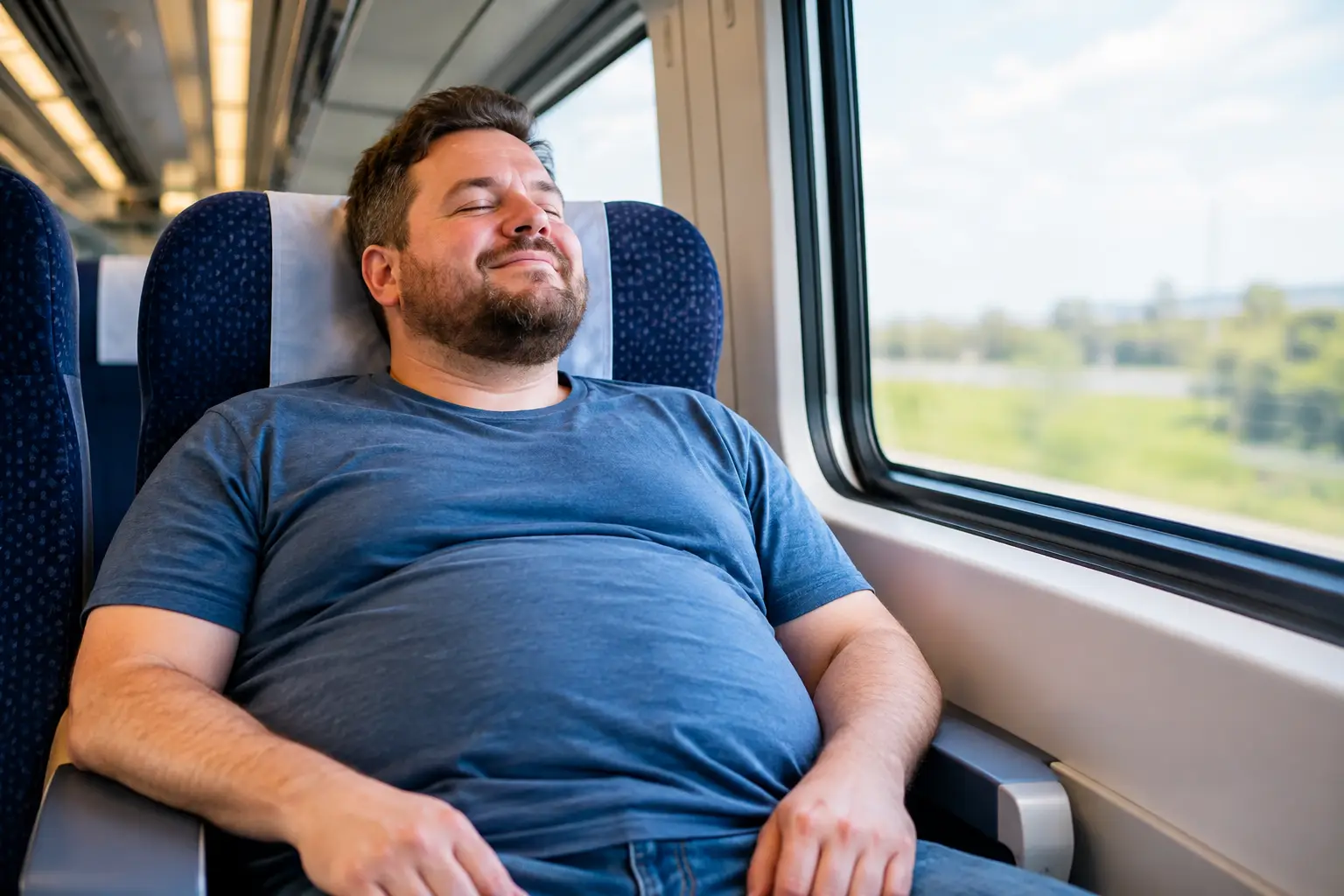
The national rail seating policy changes: commuters charging extra for sitting next to a heavy breather have finally arrived, after years of passengers pretending to look at the route map while silently assessing whether the person beside them will spend the next 84 minutes exhaling through one determined nostril.
Under the proposed scheme, commuters may add a modest “ambient inconvenience supplement” to any spare seat next to them. The charge rises according to the fellow traveller’s respiratory volume, breakfast choice and willingness to narrate their own emails aloud.
National Rail officials insist the measure is about “passenger choice”, a phrase which has traditionally meant people will be offered three options, all of them terrible, with a biscuit at Birmingham New Street if the signalling allows.
A fare structure for the breathing community
The policy, reportedly trialled on a 07:12 service that never actually made it beyond Stowmarket, divides heavy breathing into four categories. Level One covers the gentle, slightly damp sighing of somebody who has jogged for a train in office shoes. Level Two is for audible nasal weather systems. Level Three applies when a passenger sounds as if they are trying to inflate a lilo through a drinking straw.
Level Four, known internally as “The Norwich Express”, is reserved for commuters whose breathing causes fellow travellers to check whether the train has developed a mechanical fault.
A standard seat next to a Level Four breather could cost an additional £6.40, although travellers may avoid the surcharge by standing in the vestibule beside the toilet, a privilege currently priced at £112.50 plus a booking fee.
“We are not punishing anyone for having lungs,” said a National Rail spokesperson, speaking from behind a laminated notice that read PLEASE DO NOT SPEAK TO STAFF. “We are simply recognising that some lungs have a greater impact on the public realm than others.”
The spokesperson added that the policy would be “fair, transparent and subject to a 19-page exceptions process available only through an app which crashes when opened near rail infrastructure”.
Ipswich commuters smell a revenue opportunity
Commuters at Ipswich station greeted the announcement with the sort of pragmatic enthusiasm usually reserved for finding an empty table near a plug socket.
“I’ve been doing it informally for years,” said local accountant and self-appointed carriage marshal, Derek Plume. “If someone gets on with a sausage roll, a backpack the size of a small conservatory and the breathing pattern of an asthmatic accordion, that’s premium adjacency. Basic economics.”
Mr Plume said he planned to accept contactless payment, cash and one unopened packet of salt-and-vinegar Squares. His preferred customers are quiet people with headphones, no luggage and a visible sense of shame about existing.
At the other end of the carriage, Felixstowe resident Sharon Bell said the changes could restore dignity to rail travel. “Last Tuesday I sat beside a man who breathed heavily, watched videos of farm machinery and peeled two hard-boiled eggs before Colchester. I don’t think £4.50 is unreasonable. Frankly, I’d have paid more for the egg situation alone.”
Not everyone is convinced. The Suffolk Association for People Who Merely Have Faces That Look Tired warned that commuters could be wrongly classified after running for a connection, carrying a pram, or simply attempting to understand the ticket barriers at Stratford.
The quiet carriage has gone too far
The scheme comes after a difficult year for the quiet carriage, which rail operators admitted had become less a peaceful zone and more a laboratory for passive aggression.
Existing rules prohibit loud phone calls, music without headphones and “unnecessary disturbance”. Yet nobody has been able to establish whether the man repeatedly opening and closing a bottle of fizzy water is more or less necessary than the woman loudly whispering, “Some people are trying to work.”
The new policy would allow passengers to rate their immediate neighbour using a discreet in-app system. Categories include “Breathing”, “Leg geography”, “bag on seat”, “speakerphone confidence” and “smells of wet dog but appears not to own one”. A score above eight triggers a fare adjustment and, in severe cases, a small cardboard screen emblazoned with the words PERSONAL SPACE HAS BEEN COMPROMISED.
Rail campaigners have questioned whether this may encourage discrimination against people with health conditions. Ministers responded by appointing a taskforce chaired by a former management consultant who once took a train to York and described it as “a fascinating user journey”.
Its first recommendation was expected to be a pilot programme, because Britain cannot confront any problem without first putting it in a lanyard, calling it a pilot and launching it in three towns nobody can reach after 6pm.
A surcharge, but make it British
The genius of the proposal is its refusal to solve the underlying issue. Rather than provide enough seats, carriages, staff or a timetable that treats “09:03” as anything more than aspirational, passengers will be encouraged to monetise one another’s discomfort.
It is a distinctly British compromise. Nobody needs to say, “Could you possibly breathe a little less like a haunted harmonium?” Instead, they can send a polite digital invoice and stare fixedly at a copy of the Metro.
One leaked guidance note suggests that travellers should phrase the request delicately. Recommended wording includes: “I hope you don’t mind, but due to the immersive nature of your respiratory presence, this seat has moved into Band C.” A more direct option, intended for Friday evenings, reads: “That’ll be £3.20, pal.”
The document also advises staff not to intervene unless a disagreement becomes “audible across multiple ticket zones”, at which point it will be reclassified as a cultural event and advertised by the council.
Could it actually work?
In the narrow sense that it might generate money while making everyone slightly angrier, yes. Rail operators believe the policy could raise millions, most of which will reportedly be invested in new signs explaining why the next train has been cancelled.
There are complications. A passenger may begin a journey as a perfectly acceptable neighbour, then become a heavy breather after sprinting from Platform 8 to Platform 2 because the platform was changed with the timing and clarity of a minor military coup. Who pays then? The consultation proposes a breathing reassessment at each stop, conducted by a guard equipped with a clipboard and the exhausted expression of someone who has heard every possible complaint about a bicycle.
There is also the problem of couples. Under current draft rules, a partner may sit beside a noisy breather for free, provided they can prove they have “historical familiarity with the condition”. This is expected to cause administrative delays at ticket gates across East Anglia as thousands produce anniversary cards, joint mortgage documents and screenshots of arguments about snoring.
A separate exemption may apply to supporters travelling home from football, on the grounds that nobody can identify a heavy breather among 400 people eating chips, singing badly and wearing a shirt from 2003.
The real premium is an empty seat
For all the jokes, the idea has struck a nerve because every commuter knows the true luxury on a packed train: not first class, not a tiny cup of tea, not even Wi-Fi that briefly connects before asking you to sign in again. It is the empty seat beside you, untouched by knees, elbows, tuna mayonnaise or somebody’s loud personal journey through probate.
Perhaps the fairer answer is not to charge the public according to nasal acoustics, but to run trains with enough room for people to sit down without conducting a full social and biological risk assessment. Until that glorious day, keep your headphones charged, your manners intact and, if you must breathe heavily, consider doing it in first class.