
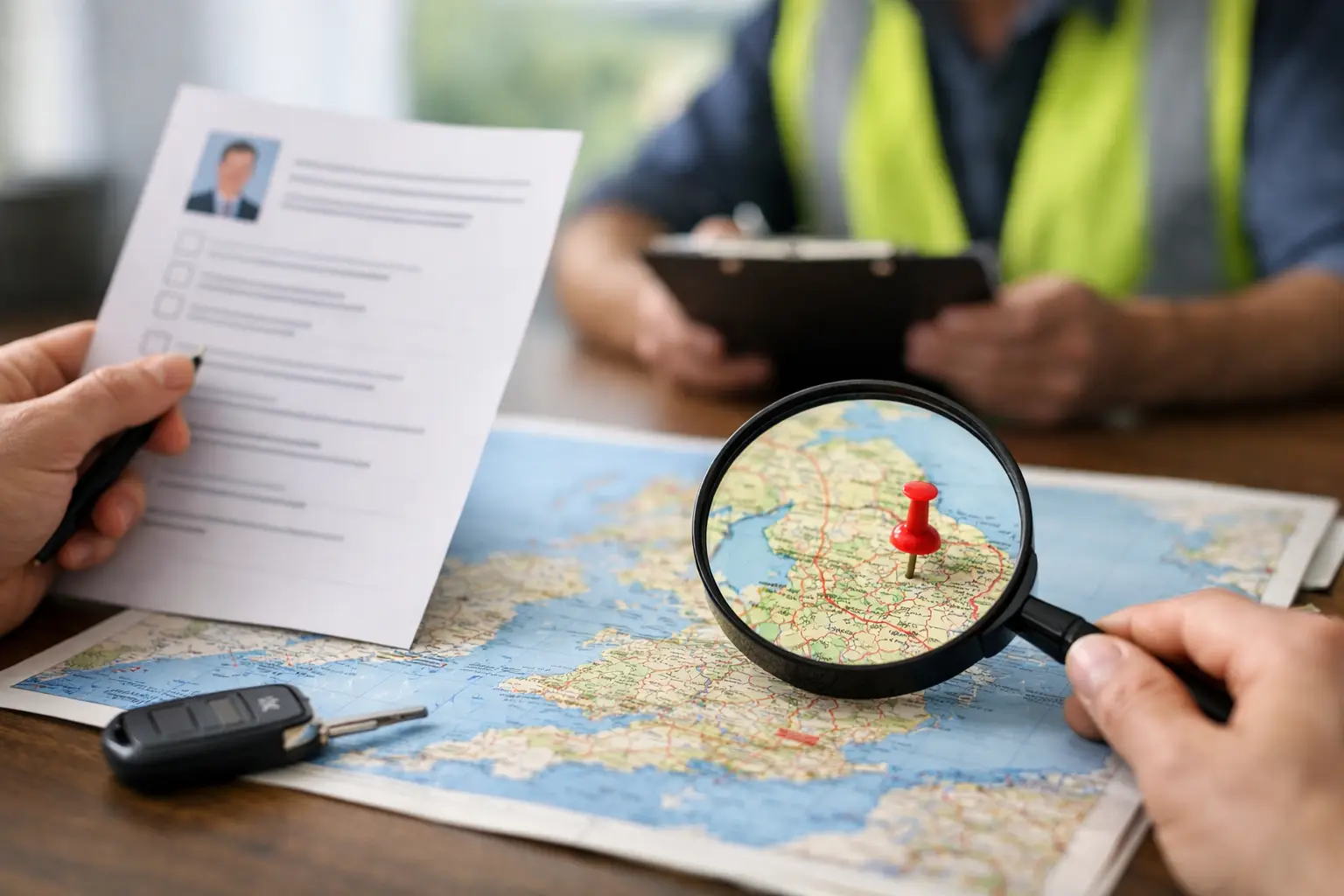
A DVLA driving licence check fails drivers who cannot identify Norfolk, according to a completely fabricated Government pilot designed to stop people entering East Anglia merely because they saw a brown sign for a garden centre.
By Our Norfolk Reporter: Ian Bred
The new online system, said to have been trialled at 3.17pm on a wet Tuesday, asks applicants to locate Norfolk on a map of Britain before allowing them to renew a licence, check penalty points or prove they are legally entitled to sit in a stationary Vauxhall Corsa outside a retail park.
Those who point at Cornwall, Cumbria or, in one particularly troubling case, “somewhere near Belgium” are immediately redirected to a page featuring a picture of a tractor, a grey sky and the words: “Have another go, sunshine.”
DVLA driving licence check fails Norfolk doubters
Officials from the imaginary Department for Transport said the measure was introduced after years of motorists arriving in Norfolk “with neither a map, a plan nor any apparent awareness that roads can continue for longer than 12 miles without a Pret”.
The test begins innocently enough. Users are shown an outline map and asked to click on the county famous for windmills, vast skies, enormous villages with one pub left, and a population capable of discussing the A47 as if it were a prolonged military conflict.
Most drivers reportedly pass within seconds. Problems begin when the system asks follow-up questions such as whether Norwich is “basically Suffolk but bigger”, whether Cromer counts as the seaside if you have brought a thermos, and whether someone from King’s Lynn is allowed to say they are from “near Cambridge” at weddings.
One motorist from Milton Keynes, who asked not to be named because he had just told three people he was a “bit of a county man”, failed the check after identifying Norfolk as “the bit above London where everyone owns a boat”.
He has been granted a temporary licence restricted to driving between dual carriageways, airport car parks and any branch of a national coffee chain with easy access to a charging point.
The map question causing nationwide panic
The fictional DVLA interface is allegedly colour-coded to help confused applicants. Suffolk appears in a reassuring shade of beige. Norfolk is represented by a large yellow shape accompanied by the sound of distant geese and somebody saying, “You’ll want the next turning, not this one.”
Yet campaigners say the process has unfairly exposed a deep national inability to recognise counties that do not contain a major football stadium, an international airport or a celebrity chef’s restaurant with tiny chairs.
A survey of 2,000 people invented for the purposes of this article found that 41 per cent believed Norfolk was “somewhere round the back of Cambridge”, 18 per cent thought it had been merged into Suffolk during the pandemic, and six per cent assumed it was a fictional setting from The Archers.
The remaining 35 per cent were from Norfolk and responded, in various spellings, “leave us alone, we’re fine”.
“It is not difficult,” says man with OS map tattoo
Local resident and self-appointed geographic standards officer Martin Peddle, 58, told reporters from beside a lay-by near Wymondham that the test was long overdue.
“It is not difficult,” he said, unfolding an Ordnance Survey map the size of a picnic blanket. “Norfolk is the bit sticking out on the right. It has beaches, churches, farm shops and at least seven roads that look like they are going somewhere but are actually taking you back to where you started, only wetter.”
Mr Peddle said anybody unable to find the county should be made to spend a weekend attempting to get from Diss to Holt without saying, “Surely there must be a quicker way.”
“They’ll learn,” he added. “Or they’ll settle in Thetford for 45 minutes and emerge changed.”
Drivers face compulsory regional awareness course
Those failing three attempts will reportedly be invited to attend a compulsory regional awareness course in a village hall with inadequate heating and a raffle prize consisting of two jars of chutney.
The course covers the basics: identifying a village sign, understanding why every pub claims to be “the last proper one”, and accepting that a journey of 28 miles may take an afternoon once you factor in tractors, horseboxes, a delivery van, two cyclists riding side by side and a person reversing a caravan with the confidence of a naval commander.
Attendees must also complete a practical module. They are handed a tote bag, a £10 note and a vague instruction to “find somewhere that sells a sausage roll and local honey”. Anyone returning with a branded energy drink is asked to reflect on their choices.
A final assessment requires drivers to react correctly when a satnav insists they turn down a lane that has narrowed from “road” to “hedge-based suggestion”. The right answer, according to the training booklet, is to stop, sigh, blame technology and follow the vehicle in front, which is almost certainly going to the same farm shop anyway.
Suffolk responds with customary suspicion
Across the border, Suffolk residents have reacted to the news in the traditional manner: by pretending they do not care while caring with impressive administrative thoroughness.
Some welcomed the proposed test, arguing it would reduce the number of visitors who arrive in Bury St Edmunds looking for the coast, then complain that the county has been arranged incorrectly. Others feared Norfolk identification could become the first stage of a wider national programme requiring motorists to distinguish Ipswich from “that place with the football club and roundabouts”.
One Suffolk parish councillor, speaking entirely hypothetically, warned that any scheme involving county recognition must be fair, transparent and conducted only after the examiner has demonstrated an acceptable knowledge of Stowmarket’s position, pronunciation and emotional significance.
“There are boundaries,” she said. “Some are historic, some are ceremonial, and some are caused by a tractor doing 19mph on the B1115. But they matter.”
Ministers deny scheme is anti-outsider
Fake ministers have denied that the new test is hostile to outsiders, saying it merely ensures visitors possess the minimum awareness needed to order lunch without asking whether the fish is “locally sourced”.
A spokesperson said: “Britain’s roads are for everyone. But if you intend to drive through Norfolk, it is reasonable to know that it exists, that it is not a shortcut to London, and that a sign reading ‘Unsuitable for motors’ is not an invitation to test the limits of your leased SUV.”
The spokesperson declined to say whether similar checks would be introduced elsewhere. Reports that drivers entering Yorkshire may soon need to recognise a proper pint, or that anyone approaching Cornwall must identify a pasty under oath, could not be confirmed because they were made up five minutes earlier.
A small victory for maps everywhere
For now, motorists are advised not to panic. Real DVLA services do not demand a working knowledge of East Anglian geography, nor do they dispatch a county elder to inspect your glovebox for a laminated atlas.
Still, there is a useful lesson in the nonsense. Before setting off somewhere unfamiliar, glance at a map, allow more time than the satnav suggests, and never assume a route through the countryside will be quick simply because it looks like a straight line. If you can identify Norfolk as well, so much the better. You couldn’t make it up.