
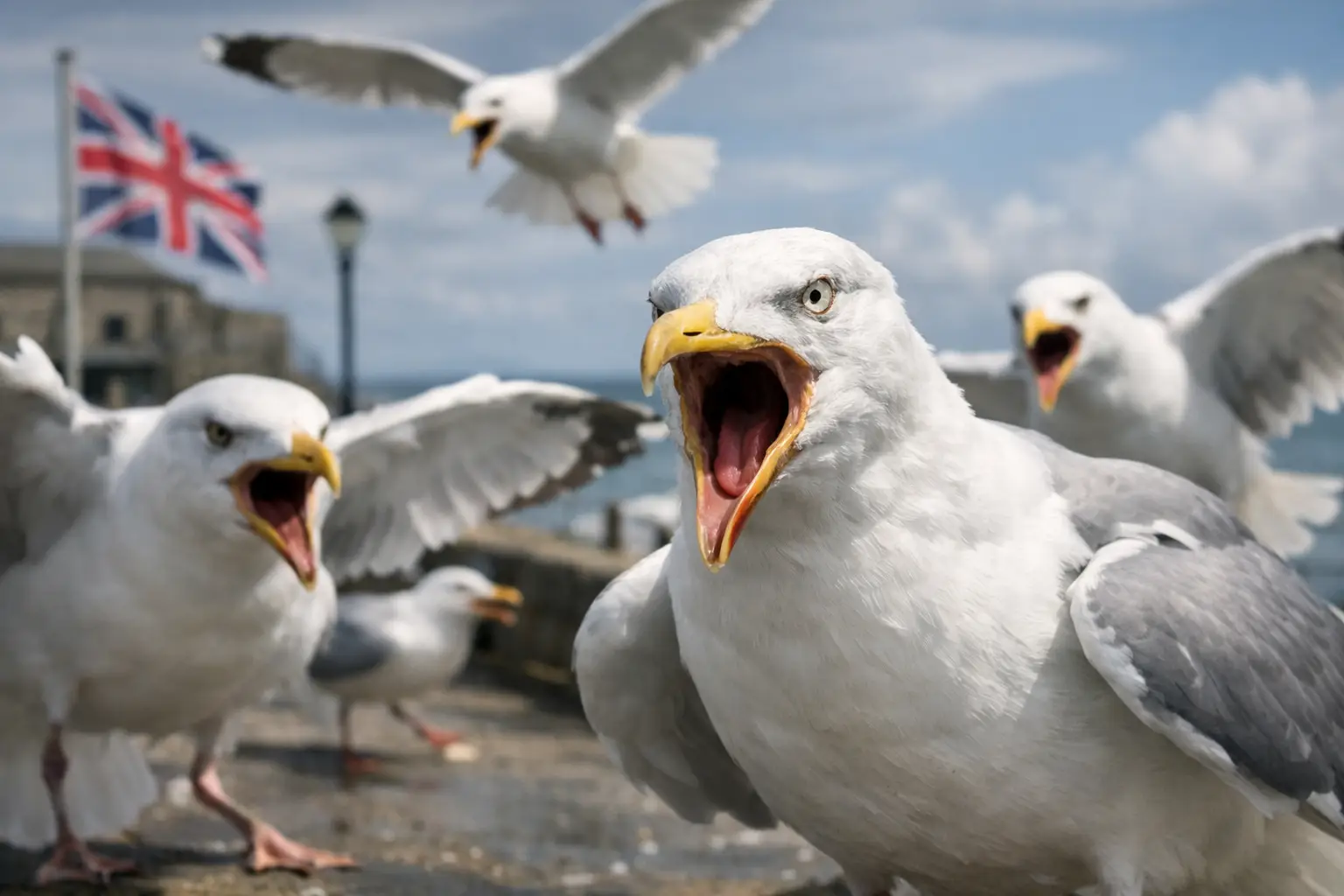
On a perfectly ordinary British seafront, an elderly man from Lowestoft lost half a doughnut, his glasses and, by his own account, “all remaining faith in coastal civilisation” after an encounter with angry seagulls near the promenade. Witnesses said the birds arrived with the confidence of undertrained private security and the moral restraint of a rogue parking contractor. By noon, three chips, one ice cream and what police later described as “a lightly supervised sausage roll” had also gone missing.
This is no longer a seasonal nuisance. It is, if the nation’s benches, bins and traumatised holidaymakers are to be believed, a fully fledged avian campaign. Across Britain, angry seagulls have moved well beyond casual scavenging and into what one council source called “opportunistic domination of public space”. They scream outside Greggs, patrol market squares and descend on picnic areas with the tactical discipline of a non-league away end.
Why angry seagulls now seem absolutely everywhere
The official explanation is usually dull. Experts talk about food waste, urban nesting, changing habitats and the fact people keep waving battered cod around like surrender flags. All true, probably. But it does not quite explain the brazenness.
The modern seagull no longer behaves like a bird. It behaves like a minor local official who knows no one can challenge its authority without filing three forms and waiting six to eight weeks. It stands in the middle of the road. It stares into café windows. It inspects prams. In several coastal towns, residents report gulls pecking at meal deals with the air of a seasoned shopper checking yellow-sticker reductions.
Part of the problem is branding. “Seagull” suggests a breezy, postcard sort of creature, perhaps hovering prettily above a pier while a child drops a chip in slow motion. In reality, many of these birds are urban opportunists with the temperament of a caller on local radio who has been on hold since quarter past eight.
And because they are everywhere, people have started adapting to them in quietly absurd ways. Families now eat lunch under strategic cover. Pensioners clutch pastries to the chest like wartime documents. A man in Felixstowe was seen using an umbrella in full sunshine, not for the weather but to create what he termed “an anti-gull defence dome”. Neighbours described the system as “a bit much”, right up until it worked.
The seaside snack economy has been changed by angry seagulls
No serious conversation about modern Britain can ignore the effect these birds have had on chips. The humble tray, once a symbol of carefree coastal pleasure, now resembles a high-risk asset. The buyer receives the goods, scans the skyline, adjusts stance and prepares for impact.
Vendors have responded with the ingenuity usually associated with wartime rationing or village fete disputes. Some serve food in partially covered boxes. Others issue warnings with the solemnity of a pharmacist discussing side effects. “Do not stand under the lamp post” has become, in some places, as common as “Mind the step”.
One café owner in Southwold, speaking with the haunted look of a man who has watched nature defeat laminated signage, claimed the gulls had learned lunch rhythms better than his staff rota. “They know when school holidays start. They know who’s from inland. They know weakness,” he said, while securing a flapjack under what appeared to be a tea towel and a gardening brick.
It would be funny if it were not already very funny. But there is an economic point buried under the feathers. A gull raid turns a £4.80 snack into an outdoor incident. It creates delays, shrieking, dramatic pointing and at least one person insisting this sort of thing never happened in the 1980s. In pure local-news terms, it is gold. In practical terms, it is lunch theft with wings.
A species powered by confidence rather than shame
Pigeons still have some decency. They look furtive. They scatter when challenged. A seagull does not scatter. A seagull reassesses. It may take one backward step, not out of fear but to secure a better angle of attack.
That is what unnerves people. Angry seagulls do not seem merely hungry. They seem convinced they are in the right. They stride across car parks as if enforcing by-laws. They heckle beachgoers from rooftops. They possess the kind of confidence usually seen in men who reverse caravans while refusing all assistance.
This explains why every encounter feels personal. The gull is not just taking your chips. It is making a point about ownership, hierarchy and your poor grip strength.
Can Britain do anything about angry seagulls
Only to a point. Councils put up notices. Traders fit bin lids. Visitors are urged not to feed the birds, which is excellent advice if your hobby is being ignored by the public. The difficulty is that gulls have grasped a basic truth about British life: if you behave badly enough in a public place, eventually everyone gives up and walks around you.
There have been the usual suggestions. More deterrents. Recorded noises. Hawk patrols. Sterner bins. Public awareness campaigns featuring cartoon gulls in hi-vis saying “Please don’t encourage aggressive scavenging.” All sound plausible until one remembers the opponent is a shrieking airborne opportunist capable of stealing a baguette from a man mid-sentence.
Trade-offs exist. People want cleaner streets but also seaside charm. They want wildlife, but not wildlife with opinions. They want to eat outdoors, but they do not want to become part of the food chain. It depends where you are, too. In some spots the birds are a background annoyance. In others they are running what looks suspiciously like a protection racket over the pier.
There is also the awkward issue of admiration. For all the complaining, Britain respects nerve. We are, culturally, a people who cannot entirely dislike any creature that barges in, takes what it wants and leaves everyone muttering. The seagull is appalling, yes, but it is appalling with conviction.
Local authorities consider stronger messaging
Mock-serious discussions are reportedly taking place in assorted town halls about whether seagull warnings need tougher language. Traditional signs saying “Do not feed the gulls” may be replaced with more realistic notices such as “Conceal all pastries” and “Maintain eye contact during chip transit”.
A draft coastal safety leaflet seen by nobody reliable also recommends avoiding unnecessary rustling, never opening vinegar sachets in exposed areas and refraining from holding donuts aloft while chatting. One paragraph simply reads: “If challenged by a gull, remain calm. Do not negotiate.”
This is the point at which British bureaucracy meets British wildlife in a glorious stalemate. The council can print all the leaflets it likes. The gull cannot read, but it can absolutely sense panic.
What angry seagulls say about us
Perhaps the birds are not the whole story. Perhaps they have merely exposed the fragility of a society built on al fresco eating, unattended snacks and the naive belief that a paper tray offers protection. Angry seagulls thrive because we have created the ideal conditions for low-level chaos: crowded promenades, easy calories and tourists determined to look at the sea instead of the sky.
They are, in their own terrible way, a perfect British headline. Loud, opportunistic, faintly menacing, impossible to ignore and forever circling where chips are available. They cut across class, region and politics. A gull will nick from a tradesman, a banker, a dog walker or a retired colonel with equal enthusiasm. There is something almost democratic about that.
The real lesson may be modesty. Humans arrived at the coast assuming dominion over benches, bins and battered fish. The gulls reviewed the arrangement and reached a different conclusion. It is hard not to see their point when a family of five abandons a full picnic because one particularly assertive bird landed nearby and looked managerial.
If you are heading seaside this year, there is no need for panic. Just carry your lunch like state secrets, avoid flamboyant pastry displays and never mistake silence for safety. A gull that is not screaming is usually planning. And if one does take your chips, hold on to your dignity, because that, unlike the chips, is still technically yours.