
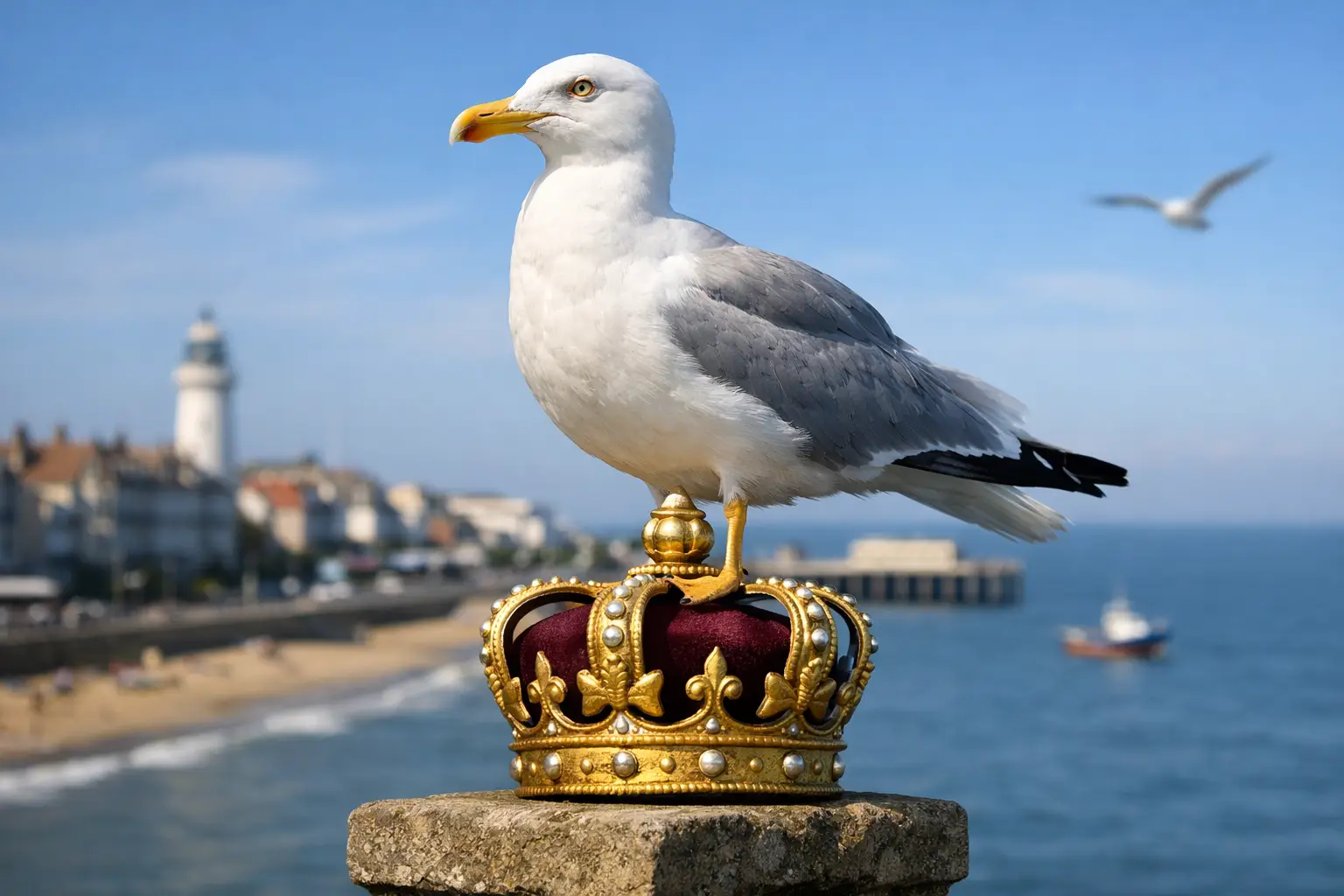
At 7.43am on Tuesday, a seagull landed on the roof of a chip shop in Lowestoft, looked directly into the middle distance, and by 8.10 was widely understood to be in charge.
Residents say the transition of power was smoother than expected. There was no coup as such, unless one counts the aggressive removal of a child’s battered sausage and a prolonged stare directed at a traffic warden as constitutional activity. By breakfast, local people had already begun adjusting. One man near the promenade was heard to say, with the flat resignation usually reserved for council tax letters, “Fair enough, really.”
How the seagull took control
Witnesses describe a level of confidence rarely seen outside county politics and men who reverse horseboxes without checking behind them. The bird, described by officials as “substantial” and by a shaken tourist from Milton Keynes as “an absolute unit”, arrived alone, strutted along a guttering edge, and issued what experts are calling a series of sharp, legally ambiguous cries.
Those cries were initially dismissed as standard seaside behaviour. However, concern grew when three other gulls appeared, formed what one shopkeeper called “a sort of airborne cabinet”, and began patrolling the seafront with the grim efficiency of private parking contractors.
By mid-morning, deckchairs were abandoned, children were moved indoors, and a council spokesperson had issued a statement saying the authority was “monitoring the seagull situation closely” while quietly eating lunch in a locked vehicle.
Local governance, never especially muscular before elevenses, seems to have yielded almost immediately. A temporary command post was established behind a candyfloss machine, but this was later overrun after an officer attempted to defend a tray of chips using only a hi-vis vest and procedural language.
Seagull policy on chips, dignity and public order
The bird’s platform, while not formally published, appears simple enough. Chips are now regarded as a communal resource. Ice cream may be taxed at source. Pasties remain vulnerable under what legal minds are calling opportunistic beak powers.
There is also thought to be a wider cultural project under way. Several visitors reported feeling watched while eating outdoors, even when holding food items of no obvious interest to a gull, including a vegan wrap and, in one odd case, a small flapjack purchased indoors and then unwisely displayed near the pier.
The seagull’s attitude to public order has been similarly brisk. It has shown little patience for dawdlers, influencers, or men who walk along the front shirtless in weather best described as optimistic. One eyewitness claims the bird pecked a smartphone out of a hand after the owner attempted a fifth retake of a “candid” walking video. Public reaction to this has been unusually supportive.
There is, locals say, a rough fairness to the arrangement. Unlike many power structures in modern Britain, the seagull has been clear about what it wants and has never once promised growth.
Lowestoft adapts to life under gull rule
Businesses have moved quickly. Several cafes have introduced indoor-only chip protocols, while one pub is trialling what it calls a vertical serving model, understood to mean handing food to customers through an upstairs sash window.
A bakery near the town centre has stopped advertising sausage rolls in its front display after repeated raids which staff described as “less theft, more state requisitioning”. Meanwhile, two souvenir shops are already selling tea towels bearing the slogan OUR GULL, RIGHT OR WRONG, which may be the most honest thing printed in Suffolk this year.
The tourism sector, never slow to monetise alarm, has adapted with admirable cynicism. There is talk of guided walks, branded binoculars and a premium “Predator at the Pier” experience for day-trippers who feel ordinary hospitality no longer carries enough emotional jeopardy.
One local B&B owner said the bird had actually improved trade. “People from inland love it,” she explained. “They come for a restful break, get mugged by wildlife, and go home feeling they’ve had an authentic coastal experience.”
Experts weigh in on the seagull crisis
Bird specialists, or at least several people in fleeces willing to speak to a reporter, say the behaviour is not entirely unusual. Gulls are intelligent, adaptable and deeply familiar with the weaknesses of human civilisation, particularly where pastry is concerned.
One amateur ornithologist from Beccles suggested the bird may simply have recognised a leadership vacuum and acted decisively. “Nature abhors a vacuum,” he said, before adding, “and gulls especially abhor an unattended portion of cod and chips.”
A retired headmaster went further, arguing that the seagull is merely exhibiting traits once admired in public life – certainty, presence, opportunism and a complete lack of shame. “If anything,” he said, “it’s overqualified.”
Not everyone agrees. A small but vocal campaign group insists the gull has been demonised by hostile coverage and is merely redistributing fried goods to the wider avian community. They have called for calmer language, although they did issue this appeal from inside a conservatory.
The political response has, naturally, been embarrassing
With a vacuum this visible, politicians have begun circling in the usual awkward way. One district figure promised a cross-party taskforce on coastal bird aggression, a phrase that somehow managed to sound both expensive and useless. Another proposed a public awareness campaign reminding visitors that waving chips in the air is, in strategic terms, unhelpful.
There was also a brief attempt to frame the seagull as an opportunity. A regional development voice described Lowestoft as “open for business, albeit under close aerial supervision”, while another suggested the bird could become a mascot for resilience, enterprise and post-Brexit snack sovereignty.
This was not universally well received. Several residents pointed out that if a giant, screaming opportunist is now the face of the local economy, there should at least be a ribbon-cutting and perhaps some grant money.
The church, for its part, has remained cautious. A vicar who asked not to be named said he did not wish to inflame tensions but admitted the bird had been seen on the parish hall roof “with an expression I would describe as Old Testament”.
Can anyone stop the seagull?
That depends what one means by stop. Preventing gulls from being gulls has historically proved difficult, rather like persuading a hen party to lower the volume or getting a parish council to finish any meeting in under three agricultural seasons.
Locals have tried umbrellas, stern language and the old seaside tactic of pretending not to have food while visibly holding food. Results have been mixed. The seagull appears unmoved by authority, sarcasm or laminated signage.
There is some hope in adaptation. People now eat faster, sit indoors more often, and have developed the sort of peripheral awareness usually found only in infantry training and supermarket reductions aisles. Children are learning valuable life lessons about vulnerability, speed and the limits of adult protection.
Even so, a negotiated settlement seems distant. The bird remains in position. It patrols the front, surveys the bins, and descends only when tribute is slow or overly wrapped.
There are whispers, naturally, that this may spread. Southwold has tightened pastry security. Aldeburgh has begun looking nervously at the sky. A woman in Felixstowe reportedly ate an entire portion of chips in her car with the engine running, just in case.
For now, Lowestoft carries on in the British way – half irritated, half impressed, and fully prepared to turn mild civic peril into a talking point by teatime. If the seagull has taught the town anything, it is that authority often goes to whoever acts as though it already belongs to them. Best keep hold of your chips, and your nerve.