
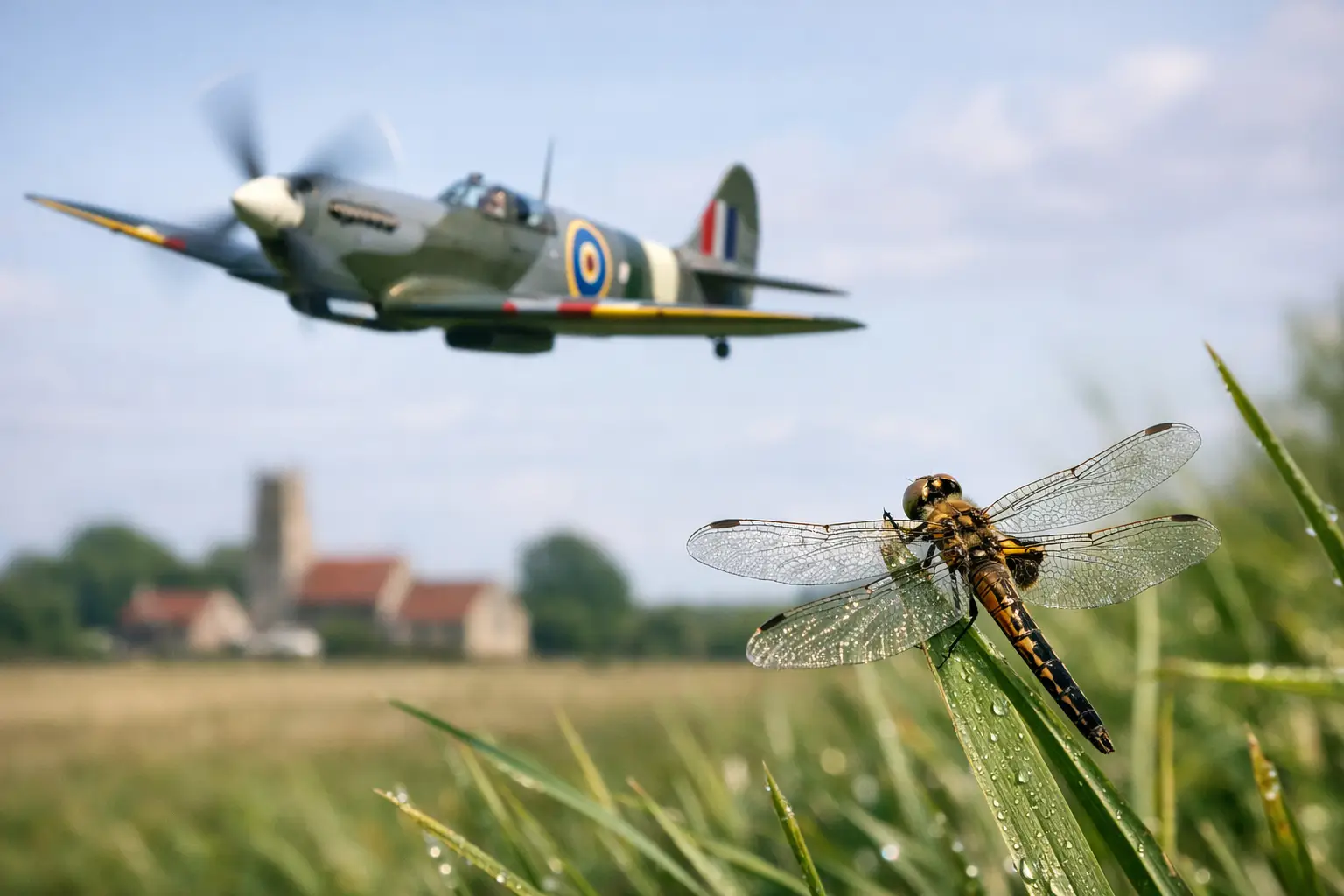
The old Buckenham Air Show Spitfire was mistaken for a giant Norfolk insect. When a retired dentist and part-time butterfly recorder, Colin Pargeter looked skyward, adjusted his bifocals and announced that Norfolk was “finally getting the wildlife it deserves”.
Mr Pargeter, 68, had been standing near a burger van at Old Buckenham Airfield when the unmistakable shape of a Second World War Spitfire appeared above the runway. Unfortunately, he had spent the previous 40 minutes explaining to his grandchildren that the county was overdue a “proper mega-moth”, and had also consumed two pints of Old Hopton Ditchwater.
“It had wings, a noise like an angry lawnmower and something hanging down at the back,” he told assembled reporters, still clutching a laminated guide to British beetles. “I said, ‘Look at the size of that Norfolk hawk-moth.’ Then it banked over the Co-op tent and I realised it was either a very unusual insect or the RAF had become much more interested in pollination.”
The aircraft was, in fact, a 1944 Supermarine Spitfire, flown by Squadron Leader Marcus Bellamy, who had been booked to perform a commemorative flypast before landing for photographs with people called Brian.
Air show paused as insect theory takes hold
What might ordinarily have been a straightforward case of a man seeing an aeroplane was rapidly complicated by social media, where a photograph of the Spitfire was posted with the caption: “GIANT BUG OVER ATTLEBOROUGH. KEEP PETS INDOORS.”
Within minutes, local Facebook groups had identified the object as a mutant emperor moth, an escaped drone from the Ministry of Defence, a chemtrail wasp, and, in one particularly firm contribution, “definitely the thing from that film where everyone gets shrunk”.
By 2.40pm, three members of the Norfolk Branch of the Amateur Entomological Appreciation Society had arrived at the airfield carrying butterfly nets, a magnifying glass and the calm, haunted manner of people who have been asked to attend a parish council meeting about hornets.
Society secretary Lorna Wedgewood said the group initially kept an open mind.
“We do not like to dismiss a report simply because it sounds implausible,” she said. “That is how you miss a rare species, or a councillor’s expense claim. But we became suspicious when somebody said the insect had a propeller, an RAF roundel and a pilot waving from inside it.”
The group’s inspection was delayed when Mr Pargeter suggested the creature might be “playing dead” on the runway.
A difficult species to identify
Experts later confirmed that a Spitfire can be distinguished from a Norfolk insect by a number of small but significant features. These include the wingspan, the Rolls-Royce Merlin engine, and the fact that insects are generally not maintained by a volunteer team in matching fleeces called Dave.
Norfolk Wildlife Response Unit spokesman Graham Pilch said calls concerning oversized wildlife were not uncommon during the summer months. Recent reports have included a muntjac “with the face of a disappointed vicar”, a pigeon “carrying a small suitcase”, and what turned out to be a Lidl carrier bag caught in a telegraph wire.
“People see what they are prepared to see,” Mr Pilch explained. “If you are at an air show, surrounded by aircraft, and you see a Spitfire, you might think: that is a Spitfire. But if you have just read a Facebook post about killer crane flies and your uncle says he saw a ‘massive buzzer’ near Diss in 1987, the mind can go elsewhere.”
Old Buckenham air show Spitfire mistaken for giant Norfolk insect
The confusion reached its peak when a child asked whether the Spitfire could sting. This prompted an impromptu safety announcement from the event organiser, advising visitors not to approach any aircraft, insect or unidentified flying object without first checking whether it had been cordoned off with red-and-white tape.
A separate announcement reassured nervous dogs that the plane was unlikely to lay eggs in their water bowls.
Squadron Leader Bellamy, who has flown at displays across Britain, said it was not the strangest reaction his aircraft had received. “At an event in Kent, a gentleman asked if it was a replica because he remembered the real ones being black and white. In Lincolnshire, somebody wanted to know where we plugged it in. This is the first time I have been mistaken for a giant invertebrate, although I am delighted to have broadened the public’s interest in aviation.”
He added that the Spitfire was not, to his knowledge, endangered, migratory or attracted to porch lights.
The pilot then politely declined an offer from a local woman to release the aircraft “somewhere quiet near Thetford”, explaining that it had a scheduled appearance at an air show in Essex and was already insured for more than her bungalow.
The jam jar question
Matters became briefly tense when Mr Pargeter returned from his car with a large empty pickled-onion jar and a tea towel.
He insisted he had only intended to “get a closer look” at the alleged insect, but was persuaded to stand down after being shown a photograph of the Spitfire alongside a peacock butterfly.
“When you put them next to each other, it is obvious,” he conceded. “The butterfly is much smaller.”
Mr Pargeter has since apologised to the aircrew, the entomologists and one marshal he accused of “harbouring a wartime beetle”. He remains convinced, however, that the airfield should investigate a suspiciously large bluebottle seen near the portable toilets.
Event organisers have said next year’s programme will include a new information board titled ‘Aircraft or Bug?’, featuring helpful comparisons for families. It will explain that a biplane is not a dragonfly, a Lancaster bomber is not a queen ant, and a Red Arrow is not “eight red bees doing Brexit”.
There are, as ever, exceptions. A mosquito has no fixed landing gear, but can cause considerably more damage to a British summer afternoon.
By close of play, the Spitfire had completed its display, the insect society had returned to its marquee, and visitors were able to resume eating ice cream while pretending they knew the difference between a Hurricane and a Harrier. Mr Pargeter left with his grandchildren, a commemorative programme and a renewed interest in aviation.
“I will be more careful next time,” he said. “Though if it turns out there is a giant Norfolk insect, I want it on record that I was first to spot it. And I still think it should get a flypast.”