
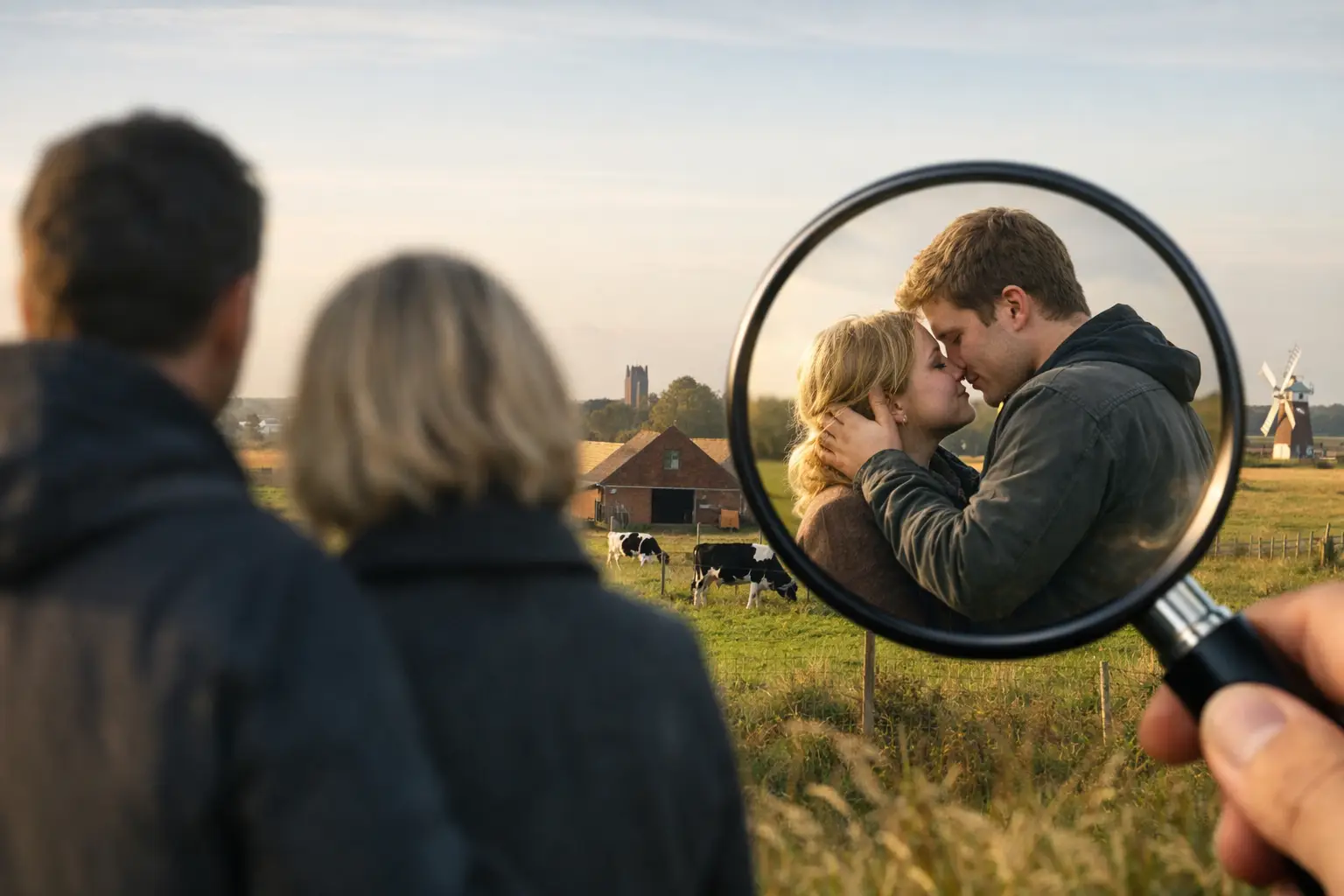
By 9.14am, the phrase “norfolk inbreed” had already been muttered twice in a market town café, once by a man in a Norwich City jacket and once by his cousin, who insisted he was only there for the breakfast offer and not to marry into it. Such is the life cycle of the East Anglian stereotype: half joke, half insult, fully recycled. The question is not whether people say it. They plainly do. The real question is why this particular gag survives like a windblown gazebo at the Royal Norfolk Show.
By Our Norfolk Reporter: Ian Bred
For balance, we sent no reporters anywhere and simply stared meaningfully across a field. What emerged was a picture of a county long reduced to one tired punchline by people who think regional wit begins and ends with calling someone their own uncle. Norfolk, naturally, has denied everything while also asking whether Suffolk would prefer to discuss six-toed banjo diplomacy at a later date.
What people mean by “norfolk inbreed”
When people use the phrase “norfolk inbreed”, they rarely mean it as a measured genetic assessment prepared by sober academics in cardigans. They mean “rural”, “odd”, “not from London”, or in many cases “I once got lost near Dereham and never emotionally recovered”. It is a shorthand insult, built from old class sneers, county rivalry and the national urge to laugh at anyone who still knows what a sugar beet looks like.
Like most lazy stereotypes, it works because it is simple, not because it is true. Norfolk is vast, flat, populated, visited, commuted into, holidayed in and occasionally escaped from by canoe. Yet in the national imagination it remains a semi-mythic place where everyone is related, everyone says “ar”, and the local planning authority is chaired by a startled pheasant.
That image says more about the people repeating it than the county itself. Britain loves pretending parts of itself are somehow more backwards than others, especially if those parts have tractors, broads or men called Keith who know how to reverse a trailer first time.
Norfolk’s right of reply
Norfolk would like the record to show that if anyone in East Anglia has perfected hereditary stubbornness, it is the lot south of the border who still think Ipswich can become Milan if you add enough artisan focaccia. The county’s unofficial response to the charge appears to be a mixture of shrugging, eye-rolling and carrying on with superior coastlines.
In fairness, Norfolk has a decent case. Norwich is a proper city, not a decorative market square with ideas above its station. The county has universities, industry, tourists, arts venues, football trauma and enough traffic on a bank holiday to prove people are very willing to enter it voluntarily. This is not a hidden tribe in a reed bed. It is a modern English county that happens to contain both culture and a man selling six kinds of chutney from an honesty box.
That said, Norfolk does not always help itself. Any region that can produce a village sign featuring suspiciously similar-looking surnames, plus a pub where three generations of one family sit in the same spot discussing beet yields, is playing with fire. Satire, like kindling, needs only a spark.
The local newspaper problem
Part of the durability of the joke comes from the style in which regional Britain reports itself. Every county paper has at some point run a story involving a runaway pig, a councillor in trouble over a hedge, or a photograph of six people opening a bench. Place enough of those together and outsiders begin to think the whole county exists inside a parish newsletter produced during a power cut.
Norfolk has been especially vulnerable because it combines rural image with enough visibility to be mocked. It is known, but not defended often enough by celebrities with media training. No one from Norfolk strides onto a sofa on breakfast television and says, “Actually, Fiona, our gene pool is broader than your presenting range.” More’s the pity.
Why the joke persists in East Anglia
The truth is less biological than tribal. Suffolk and Norfolk need each other the way siblings need someone to blame for the smell in the car. The old county teasing is part border warfare, part civic performance. Suffolk accuses Norfolk of marrying the family tree. Norfolk accuses Suffolk of being Essex with delusions of heritage. Everyone feels better for ten minutes, and then somebody has to unite against Cambridgeshire.
These jokes endure because they are easy, familiar and endlessly portable. You can deploy them at the pub, on Facebook, at a village fête, or in the comments under a story about a garden centre adding a second llama. They require no evidence and almost no timing. British humour has often confused repetition with craftsmanship.
There is also the question of class. Rural counties are still treated, in some corners, as comic museums of simpler people doing mysterious local things. It is easier to laugh at “bumpkins” than admit many towns elsewhere now consist of an empty precinct, three vape shops and a man shouting at a parking meter. Norfolk becomes the punchbag for a national discomfort about decline, difference and geography.
Is there any truth behind the Norfolk inbreed cliché?
This is usually the point where a proper feature would wheel in statistics, experts and perhaps a map with anxious colouring. We prefer a more rigorous method: common sense and the observation that people move house. They fall in love, make poor choices, improve those choices, relocate for work, attend university, marry outsiders, flee Norwich rent, return for Christmas, and spend decades mixing with the rest of Britain in entirely ordinary ways.
Counties are not sealed Tupperware tubs. They are full of commuters, newcomers, students, second-home owners, retirees and people who arrived for a long weekend in Cromer and somehow ended up chairing the parish carnival. The cliché depends on imagining Norfolk as isolated beyond reason, which might have been easier before sat-nav, trains and the invention of pretending to enjoy paddleboarding.
What does exist, if we are being fair, is the phenomenon of old local families in small places knowing each other extremely well. But that is called village life, not a medical documentary. Every county has pockets where half the pub went to school together and the other half are related by marriage, argument or both. Norfolk is not unique there. It is merely the one people keep naming because the joke scans nicely.
The danger of a joke that thinks it’s harmless
Most people saying it are not conducting a campaign of anti-Norfolk hostility. They are reaching for an old bit of county banter and hoping nobody asks them to improve. Even so, repeated clichés flatten real places. They turn a county into a costume and its residents into stock characters.
That matters because Norfolk is not just a set-up for a joke about family trees folding inwards. It is workplaces, schools, farms, estates, high streets, seaside towns, conservation battles, housing rows and all the ordinary complexity that local stereotypes politely ignore. Once you reduce a place to one stale gag, you stop seeing anything interesting about it.
Satire works best when it punches up or at least sideways with some imagination. Merely chanting the same line about webbed feet and suspiciously close cousins is less satire than administrative laziness. It is the comic equivalent of serving instant mash at a wedding.
A better class of East Anglian insult
If one insists on teasing Norfolk, and Britain plainly does, there are richer targets available. You could mention the annual chaos of escaping the coast after a hot Saturday. You could mock the city’s ability to turn one ring road issue into an epic saga in twelve parts. You could point out that every attractive village now contains one cottage worth £900,000 and one shed listed as “ideal for conversion subject to impossible permissions”.
These are at least contemporary jokes. They recognise Norfolk as a living place rather than a folklore exhibit. They also allow Norfolk to fire back with equal force about Suffolk house prices, maritime self-importance and the county’s enduring belief that putting a festival in a field counts as public transport policy.
This, really, is the trade-off. Regional mockery can be affectionate and funny when it is specific, current and self-aware. It curdles when it relies on stale ideas about who counts as civilised. Norfolk deserves the dignity of better heckling.
So if you hear “norfolk inbreed” tossed into conversation as though it remains the last word in wit, feel free to treat it as you would any other antique curiosity. Nod politely. Dust it off. Put it back on the shelf next to the carry-on films and the man who still thinks calling someone “a yokel” makes him Oscar Wilde. Then ask a harder question: if a county joke has survived this long without evolving, which side is really showing signs of limited development?