
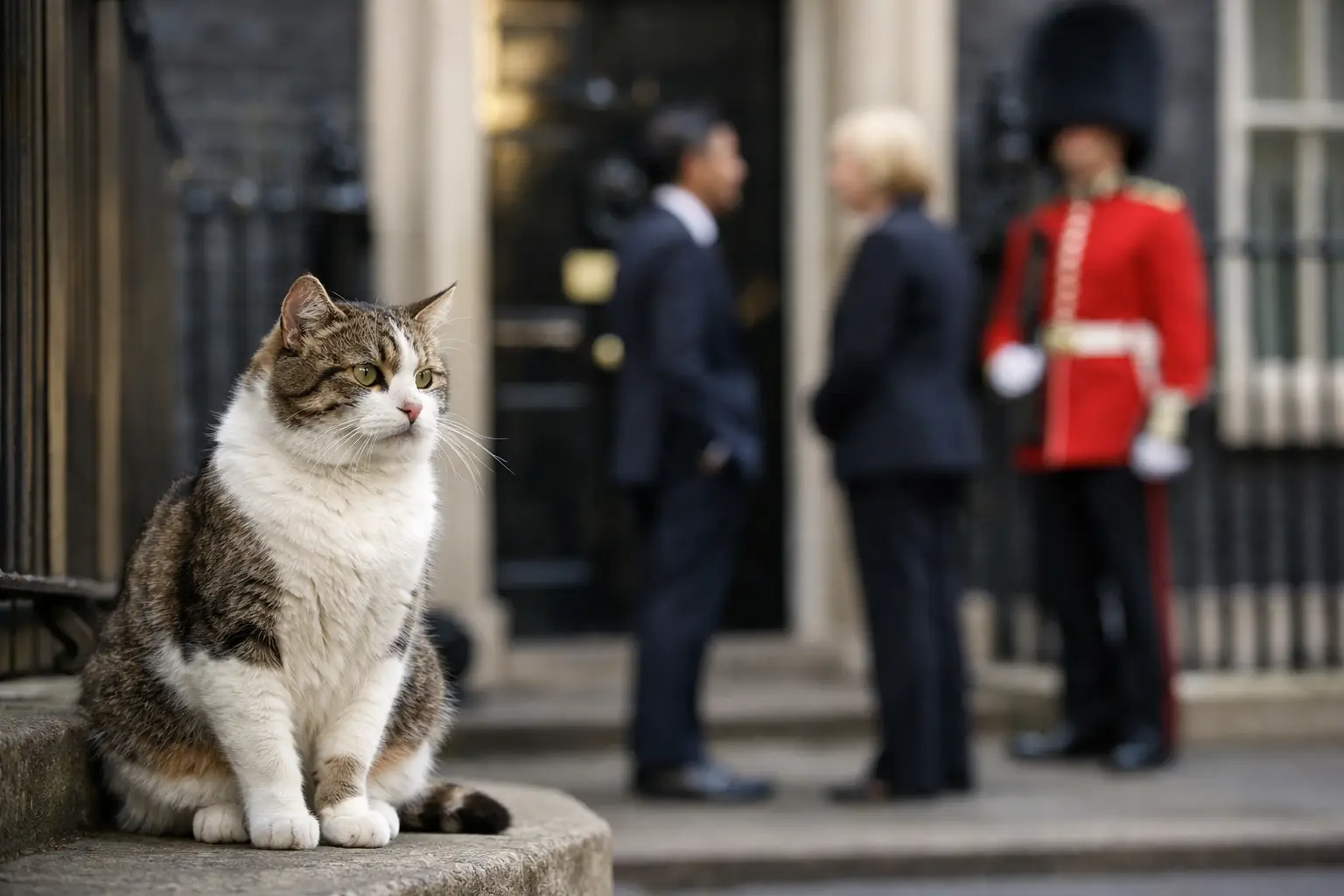
At a time when Downing Street occupants have changed more often than the reduced sandwich shelf in a late-night Co-op, larry the cat remains the one public figure Britain still vaguely trusts to sit still, look unimpressed and survive another leadership reshuffle. He has done what few ministers, advisers or slogan-writers have managed – stayed in post, avoided a resignation letter and kept a certain feline dignity while the adults repeatedly set fire to the curtains.
Why larry the cat still matters
Officially, Larry is Chief Mouser to the Cabinet Office. Unofficially, he is the nearest thing Britain has to constitutional continuity with whiskers. He arrived in Downing Street in 2011 and has since watched prime ministers come and go with the expression of a village pub landlord who has seen three stag dos, two floods and a man insist he can “still drive” after nine pints.
That is the genius of Larry. He does not campaign, he does not brief the lobby, and he has never once said he is “laser-focused on delivery” before immediately disappearing for a fortnight. He simply exists, heavily, on steps, windowsills and warm bits of government property, while around him entire administrations collapse under the weight of their own slogans.
For a British audience, especially one raised on local papers breathlessly reporting escaped swans, mystery bangs and parish council feuds, Larry is perfect material. He is both national institution and ongoing neighbourhood cat story. If he were in Suffolk, there would already be a 14-part public consultation on whether he should be allowed in the churchyard and at least one furious letter claiming he is too close to the bins.
Larry the Cat as Britain’s ideal statesman
The appeal of larry the cat is not just that he is a cat in a famous house. It is that he behaves exactly as many voters wish politicians would. He turns up when necessary, refuses to answer daft questions and looks mildly offended by the whole business. In an age of overexposure, his great strength is strategic silence.
Humans in politics are forever trying to look relatable. They pose with hard hats, hold awkward pints and talk about football in a way that suggests they believe a “final third” is a new tax band. Larry does none of this. He has never pretended to enjoy a photocall. When cameras arrive, he carries himself like a regional council chief executive reluctantly opening a refurbished roundabout.
There is also the matter of longevity. Modern prime ministers can struggle to outlast a yoghurt. Larry has survived coalition politics, Brexit warfare, leadership coups, fiscal panic and enough incoming boxes to furnish a medium-sized DFS. At this point, he is less a pet and more a load-bearing constitutional feature.
One can easily imagine a future civics textbook explaining the British system in plain terms: Parliament makes laws, the courts interpret them, and Larry the Cat silently judges everyone involved from a windowsill.
The myth, the mouse and the media circus
There is, naturally, a gap between the myth of Larry and the practical matter of whether he is especially good at mousing. Reports over the years have ranged from affectionate to diplomatically vague. Some insist he is a born hunter. Others suggest his main achievement is looking like a man who owns a successful chain of estate agents.
But that misses the point. No one expects every ceremonial figure in public life to be directly productive. We do not ask the mace to chase rodents. We do not demand that the Speaker personally patch potholes. Larry’s role is symbolic. He reassures the public that amid all the chaos there is still one creature in Westminster whose motives are refreshingly simple: food, warmth and occasional territorial warfare.
The media understands this instinctively. Larry stories perform well because they contain all the necessary ingredients of modern British coverage – a recognisable character, low stakes, a touch of constitutional weirdness and plenty of room for anthropomorphic nonsense. If Larry stares at a motorcade, it becomes a diplomatic incident. If he swats another cat, it is framed as a border conflict. If he naps, half the country regards it as the most efficient use of public property seen in years.
Larry the Cat and the politics of survival
If larry the cat teaches anything, it is that survival in British public life depends less on brilliance than on timing, stillness and a willingness to let others make fools of themselves unaided. He has never launched a vision document. He has never promised growth, renewal or change. He has simply remained in place long enough for every supposedly era-defining figure around him to become old news.
There is a lesson there for ambitious councillors and ministerial hopefuls alike. Stop speaking. Occupy a patch of sun. Let rivals self-destruct on breakfast television. Eventually someone from the BBC will describe you as a “familiar fixture”, which is politics’ version of sainthood.
Of course, there are trade-offs. Being silent and photogenic is easier when nobody expects you to reduce waiting lists or build rail infrastructure. Larry benefits from the fact that his brief is charmingly narrow. If the nation handed him actual policy responsibilities, things might deteriorate quickly. The first Budget under his supervision would probably allocate all surplus spending to tuna, draft excluders and a decorative box in the Treasury.
Still, would that necessarily be worse than some recent alternatives? Westminster has set the bar low enough for a sleeping tabby to step over it without waking.
The local paper angle Britain loves
Part of Larry’s endurance comes from how neatly he fits the grammar of British news. He can be treated as a serious constitutional mascot, a celebrity fluff piece or a petty crime correspondent depending on the day. That flexibility is gold. One minute he is greeting foreign dignitaries by ignoring them. The next, he is involved in a turf dispute that sounds like it was reported by a suburban magistrates’ court in 1978.
This is why readers keep coming back to him. Larry is one of the few figures who makes the whole absurd machinery of state feel legible. You may not understand a Treasury statement, but you understand a cat refusing to move from a doorstep while suited men hover nearby pretending this is all entirely normal.
He also gives the public a way to process political exhaustion through humour. When another government lurches into scandal, another minister appears on television looking as if they have been assembled from leftover GCSE debating club parts, Larry offers relief. He says, without saying anything, that all of this is temporary and faintly embarrassing.
That, in itself, is comforting.
What Larry the Cat says about Britain now
Britain has always had a soft spot for accidental mascots. We like institutions, but we like them best when they look slightly threadbare and baffled. Larry the Cat embodies that national preference beautifully. He is ceremonial without pomp, familiar without sentimentality and famous without ever appearing remotely grateful for it.
There is something almost heroic about his refusal to lean into the role. A lesser public figure would have a children’s range, a podcast and a memoir called Paws for Thought. Larry appears content to maintain the ancient British principle that recognition is faintly vulgar and effort should be concealed wherever possible.
Perhaps that is why he cuts through. He feels real in a landscape crowded with image management. He is not trying to win us over. He is not a rebrand. He is just there, furry and unimpressed, while history trips over its shoelaces behind him.
And maybe that is the healthiest way to regard politics generally. Not as a grand drama populated by giants, but as a revolving cast of excitable people briefly passing through a building already claimed, in spirit if not in law, by a cat with better instincts than half the payroll.
The next time another leader arrives promising a fresh start, a reset or some equally damp phrase cooked up by exhausted advisers, it may be wise to watch Larry instead. If he looks unconcerned, carry on with your tea. If he leaves the premises, then perhaps start worrying.