
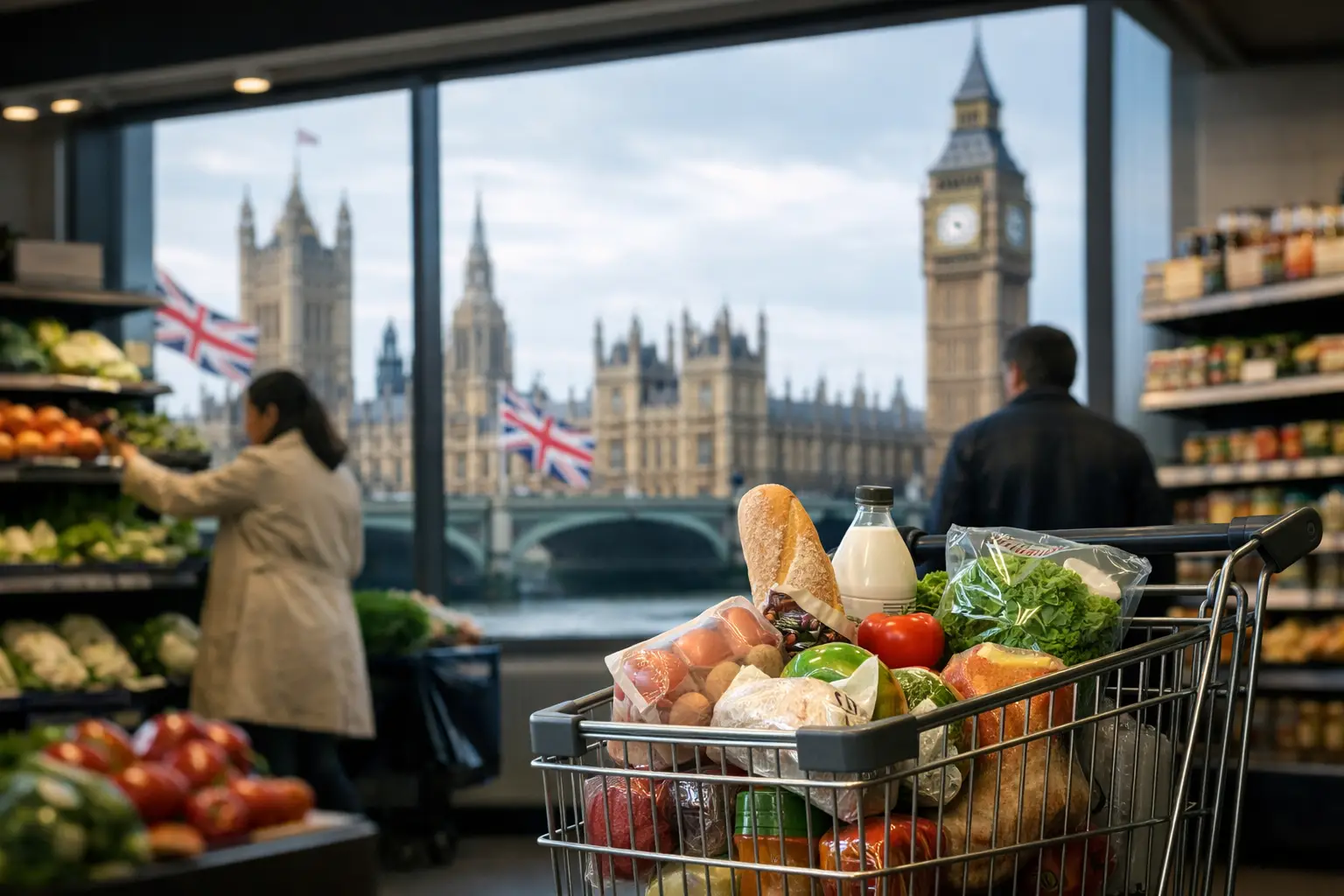
By the time a British Prime Minister has finished saying “hard-working families” for the fourteenth time, the UK supermarket has already settled the matter with a yellow sticker, a limp basil plant and one cashier quietly judging your life choices through a security mirror.
By Our Consumer Correspondent: Colin Allcabs
For all the speeches, panels and breathless political podcasts, the true state of the nation is still best measured between the bakery aisle and the reduced section. If you want to know whether Britain feels hopeful, furious or one minor inconvenience away from writing to Points of View, forget Westminster. Walk into a supermarket at 5.37pm on a Thursday and watch a man in a paint-flecked fleece hold a punnet of grapes as if it contains the answer to tax reform.
Why the UK supermarket now runs Britain
Officially, Parliament makes the rules. Unofficially, the UK supermarket decides whether the public mood is “treating ourselves” or “absolutely not”. It is where inflation becomes personal, where brand loyalty turns tribal, and where the entire economy can be understood by observing whether shoppers are buying proper butter or that anxious spread which tastes faintly of compromise.
A supermarket is not just a place to buy food. It is a theatre of British restraint. Here, adults who have managed mortgages, divorces and lower-league football season tickets can still be emotionally defeated by a self-checkout machine asking them to place the item in the bagging area with all the warmth of a hostage negotiator.
The genius of the modern store is that it has become every institution at once. It is a bank, because your finances are restructured in aisle seven. It is a restaurant, because there is sushi no one trusts but someone keeps buying. It is a pharmacy, therapist and moral examiner, because your basket tells a more honest story than your search history ever could.
Aisle by aisle, the class system survives
Britain, naturally, insists it has moved on from all that. Then someone says they shop at Waitrose and the room changes temperature. The UK supermarket remains one of the last places where people can identify your social standing from a carrier bag and three visible root vegetables.
The old stereotypes still do a roaring trade because everyone recognises them at once. Waitrose sells aspiration with a loyalty card. Marks & Spencer sells a version of adulthood in which you have somehow become the sort of person who buys olives for “nibbling”. Tesco remains the broad church of the republic, where a solicitor, a plasterer and a man buying thirty cans of energy drink all queue beneath the same sign promising Clubcard prices with the intensity of a minister unveiling a five-point plan.
Aldi and Lidl, meanwhile, pulled off the greatest reputational coup in modern retail by convincing the middle classes that bargain hunting is not just prudent but morally sophisticated. This is why you now see people emerging from Lidl with a chainsaw, a trumpet stand and six yoghurts, wearing the expression of somebody who has beaten the system.
Then there is the Co-op, which survives largely because it exists exactly where you are too tired to go anywhere else. No one enters a Co-op in triumph. They arrive the way ancient mariners reached shore – winded, dazed and prepared to pay £2.95 for a sandwich because fate has spoken.
The meal deal is our last functioning social contract
If Britain has a constitution, large parts of it are held together by the meal deal. Economists may prefer to use inflation figures and labour data, but ordinary people know the truth. The health of the nation can be assessed entirely by whether the snack, main and drink still feel like a bargain or whether the whole thing now resembles a financial prank.
The meal deal matters because it offers order in a collapsing world. You may not know where the country is heading, but at least there is a system. You choose a sandwich, reject the disappointing pasta, briefly consider a wrap to feel contemporary, and then spend too long deciding whether sparkling water is a sensible choice or evidence that life has gone badly wrong.
No Chancellor has ever commanded the same emotional engagement as a yellow shelf label announcing that a triple chocolate mousse is somehow included.
The middle aisle is Britain’s final frontier
There is no area of public life more lawless, more hopeful or more spiritually confusing than the middle aisle. It is sold as a retail feature and experienced as a fever dream. Here, beneath fluorescent lighting and the smell of cardboard, the British public are invited to purchase kayaking shoes, a soldering iron, a velvet footstool and an inflatable hot tub, often within touching distance of spring onions.
The middle aisle works because it flatters a national delusion – that all of us are one impulse purchase away from a radically improved self. The man buying a mitre saw does not need a mitre saw. He needs to believe he is about to become a sort of practical king. The woman staring at discounted yoga blocks is not entering a fitness era. She is purchasing a brief, beautiful theory of herself.
That is why people defend the middle aisle with unusual fervour. It is not clutter. It is possibility in pallet form.
Self-checkouts have created a new kind of citizen
There was a time when shopping involved a brief human interaction and perhaps a chat about the weather. Now the UK supermarket trains citizens in low-level technological humiliation. The machine does not trust you. It never has. It believes every aubergine is a potential fraud event.
This has changed the national character. Britons used to queue quietly and apologise for existing. Now they mutter at barcode readers, seek authorisation from a teenager with a lanyard, and perform the peculiar ballet of scanning one item, moving another, and trying not to trigger a flashing red light that suggests criminality over loose shallots.
And still we return, because the self-checkout offers one intoxicating promise – that perhaps this time, against all evidence, it will work normally. It never does. Yet hope survives, which is more than can be said for several public services.
Supermarket loyalty schemes know us better than government
States once maintained records. Now a supermarket app knows you panic-buy houmous every Tuesday and collapse into frozen desserts after one difficult week in March. This is not necessarily sinister. If anything, it is the most attentive relationship many adults currently enjoy.
Your loyalty card understands patterns your family politely ignores. It notices your strange seasonal commitment to pomegranate seeds. It marks your brief flirtation with lentils. It remembers the week you bought vitamins, herbal tea and a determined quantity of spinach, then quietly watched you return to crisps.
There is something almost tender in this. Not the surveillance, obviously. The discounts.
The reduced section is where character is revealed
A nation can fake confidence at full price. At 7.13pm around the reduced chiller, truth emerges. Here the UK supermarket becomes gladiatorial. Perfectly civil adults hover with forced nonchalance, pretending not to monitor a staff member carrying the yellow sticker gun like a bishop bringing sacraments to the faithful.
Etiquette collapses quickly. People who would never dream of pushing in at the post office suddenly develop the tactical instincts of field commanders. Eye contact is avoided. Territory is implied. A father of three can become strangely nimble if chicken kievs drop below £1.80.
Yet there is honour here too. The reduced section is democratic. It reminds everyone that fortune is fickle, and that tonight’s luxury can be tomorrow’s dented trifle. In this sense it is more honest than the stock market and certainly more entertaining.
What supermarkets say about us
The British do not really go to supermarkets for groceries alone. We go for reassurance, routine and tiny dramas in manageable packaging. We go to prove we are sensible, then buy a bakery item the size of a paving slab. We go because the shelves, however chaotic, suggest that society has not quite given up.
That may be why the supermarket remains oddly comforting even when it is annoying. It reflects us too accurately to be dismissed. The indecision, the thrift, the low-key snobbery, the appetite for offers, the suspicion of anything labelled “new recipe” – all of it is there under strip lighting, next to the herbs.
If you want a serious reading of modern Britain, there are think tanks for that. If you want the truth, stand near the meal deals and listen. The country is explaining itself in great detail, one passive-aggressive trolley manoeuvre at a time.
And next time the headlines grow grand and someone claims to speak for the public, it may be worth remembering that the public are currently in aisle nine comparing two nearly identical tins of tomatoes and taking the matter very seriously indeed.