
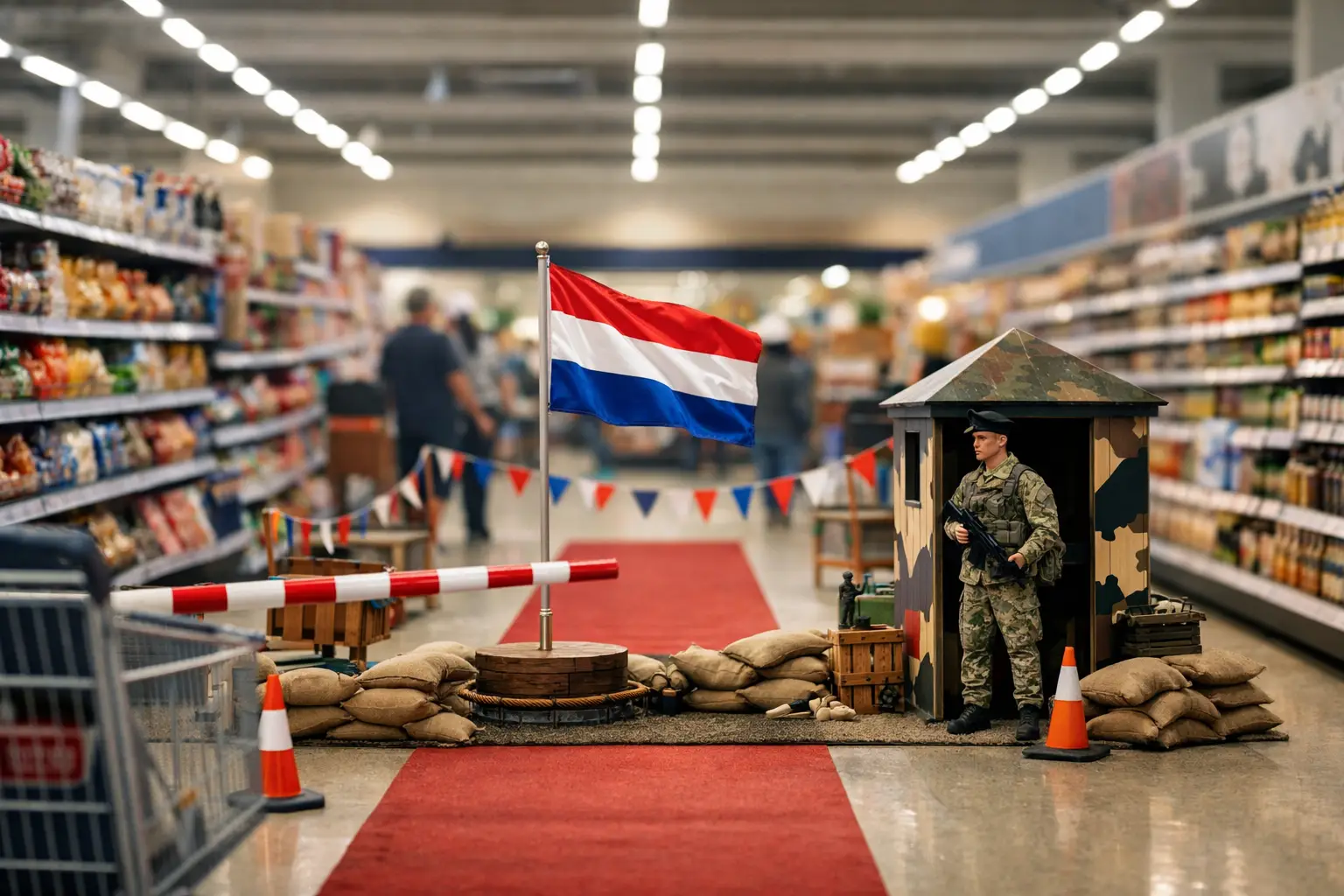
Shoppers in Suffolk say the collapse of ordinary civil life began at 9.14am on Tuesday, just after a woman in a padded gilet attempted to overtake a stationary pensioner near the own-brand tortilla wraps and was told, with unusual firmness, that she now required “the correct border documentation for Tesco Aisle 7”.
By lunchtime, the branch had installed a folding table, two plastic Union flags, and a teenager called Kyle acting as customs enforcement with the kind of confidence normally only seen in sixth form politics societies and men who have watched three episodes of The Apprentice. Tesco has not denied reports that Aisle 7, long known for wraps, houmous, novelty pickles and one abandoned basket containing only coriander, has formally broken away from the rest of the store.
Tesco confirms “limited self-checkout autonomy”
In a statement written with the grand, evasive majesty of a government defending a failed rail franchise, Tesco insisted it had not “lost control” of Aisle 7 but had granted it “limited self-checkout autonomy pending a review of regional snack governance”.
Customers appeared unconvinced. One man from Ipswich, still visibly shaken, said he had entered the aisle hoping to buy jalapeño dip and emerged twenty minutes later having paid a 14p import levy on flatbreads and pledged symbolic allegiance to what staff were calling the Free Refrigerated Republic of Midweek Entertaining.
“I only popped in for bits,” he told reporters, using the traditional phrase of the doomed. “Then a lad with a lanyard asked whether I was travelling for leisure, business or buffet purposes. Before I knew it I’d declared three mini naan and lost the will to challenge anything.”
Store insiders say the trouble began when Clubcard pricing, already understood by most Britons only as a kind of supermarket astrology, achieved a new and dangerous phase. A tub of spicy hummus was reportedly labelled £2.75, £2.10 with Clubcard, £1.85 if spiritually aligned with Tesco, and free if accepted as part of a bilateral agreement with dips from the neighbouring shelf.
Life inside Tesco Aisle 7
Residents – or shoppers who paused too long comparing olives – say Aisle 7 rapidly developed all the features of a functioning microstate, if your definition of functioning is based mainly on forms, passive aggression and beige signage.
There is now, according to witnesses, a provisional government chaired by a woman called Denise who took control simply by saying, “Right, nobody panic, I’ve done PTA.” Since then, the aisle has introduced a constitution, a loyalty programme, and an emergency reserve of breadsticks held in a lockable promotional bin.
The constitution is said to be short but firm. It guarantees freedom of movement except on Saturdays between 11am and 2pm, when movement becomes theoretical. It also recognises the right of every citizen to stand motionless with a trolley at a slight diagonal while considering antipasti.
A diplomatic quarter has formed near the premium crisps. There, representatives from Pita, Crackers and Deli Meats are attempting to broker a lasting peace after the so-called Falafel Incident, in which six packs were reduced yellow-sticker style and triggered what analysts have described as a deeply British surge of low-level opportunism.
Local mothers’ groups have already begun issuing travel advice. The current guidance is to avoid the region during pre-BBQ hours and never, under any circumstances, make direct eye contact with someone guarding the final twin pack of party guacamole.
Clubcard becomes national identity document
Experts in supermarket behaviour – a discipline now sadly more relevant than ever – say Tesco may have stumbled into nation-building by mistake. The Clubcard, once a harmless token of quiet savings and personal data surrender, has evolved into something closer to citizenship.
Without one, shoppers report being treated like stateless wanderers, permitted to observe but not to benefit. One elderly gentleman from Stowmarket claimed he was escorted to a neutral zone near toiletries after attempting to buy kettle chips at the non-Clubcard rate, which staff allegedly described as “an unfunded luxury position”.
Those with a Clubcard, however, enjoy privileges bordering on the feudal. Discounts are bestowed. Gates part. Coupon offers descend from the heavens with the cryptic force of medieval prophecy. It is not yet clear whether dual nationality with Nectar remains possible, though constitutional lawyers in retail have urged calm.
One source close to the matter said Tesco had considered issuing passports but abandoned the idea after discovering most customers already carry enough cards to wallpaper a modest semi in Lowestoft.
Border tensions spread to meal deal territories
The crisis widened in the afternoon when the meal deal chiller declared itself a “special economic zone” and introduced differential pricing based on whether a shopper looked decisive enough to merit a premium side.
That move has drawn criticism from neighbouring sectors. Bakery officials accused meal deal ministers of “reckless fiscal adventurism” after a sausage roll was reclassified as a strategic asset. Meanwhile, the fruit section attempted neutrality but was ignored, as usual, by almost everybody under 43.
Tesco staff, many of whom arrived simply expecting a normal shift of barcode-related sorrow, have adapted with admirable resignation. One employee said the branch had received no formal training in aisle diplomacy but had been advised to smile, keep shelves faced up, and avoid saying “for God’s sake” within earshot of customers filming for Facebook.
There have been isolated clashes. A retired colonel reportedly attempted to annex part of the olives shelf by placing his basket across it lengthways and declaring, “This is now under temporary administration.” The situation de-escalated only when his wife said, “Gerald, stop being strange,” a phrase with a long and successful history in British conflict resolution.
Tesco shoppers adapt with usual quiet despair
If there is one thing the British public can do, it is accommodate total nonsense provided it comes with fluorescent labels and a vague queueing system. By early evening, shoppers had adjusted to the new order with minimal fuss.
Some began carrying their receipts visibly, in case patrols asked for proof of lawful purchase. Others adopted the local custom of muttering “absolute state of it” before proceeding exactly as normal. A few younger customers embraced the moment and were seen applying for residency in Aisle 7 because “it’s got better vibes than the freezer section”.
Economists predict the sovereign aisle model could spread. There are already rumours that the middle aisle at Aldi is considering a loose confederation based on discounted pressure washers and emotional instability, while a Morrisons salad bar has apparently collapsed into military rule.
For Suffolk shoppers, though, the Tesco situation feels especially personal. Supermarkets are no longer mere places to buy tea bags and feel judged by avocados. They have become the theatre in which modern British life performs itself most honestly – polite, confused, rule-bound, faintly resentful, and somehow always one reduced trifle away from administrative breakdown.
Nobody is pretending this will be resolved quickly. Negotiators are still working through thorny questions involving tariff-free houmous, the status of poppadoms, and whether self-checkouts can be recognised as sentient observers under international till law. A spokesperson refused to comment on claims that Aisle 7 may soon seek observer status at the parish council.
Still, there are signs of hope. At the time of going to press, a cross-party delegation of dads in zip fleeces had entered the disputed territory carrying multipack crisps and a folding sense of purpose. Their plan, sources say, is to restore peace by suggesting everybody “just gets what they need and heads off” – a proposal widely admired for its optimism and total lack of contact with reality.
Until then, customers are advised to shop carefully, keep their Clubcard within reach, and remember that sovereignty, like reduced houmous, can appear suddenly and in deeply inconvenient places. If all else fails, there is always the small local shop, where things cost more but at least the feta has not yet formed a government.