
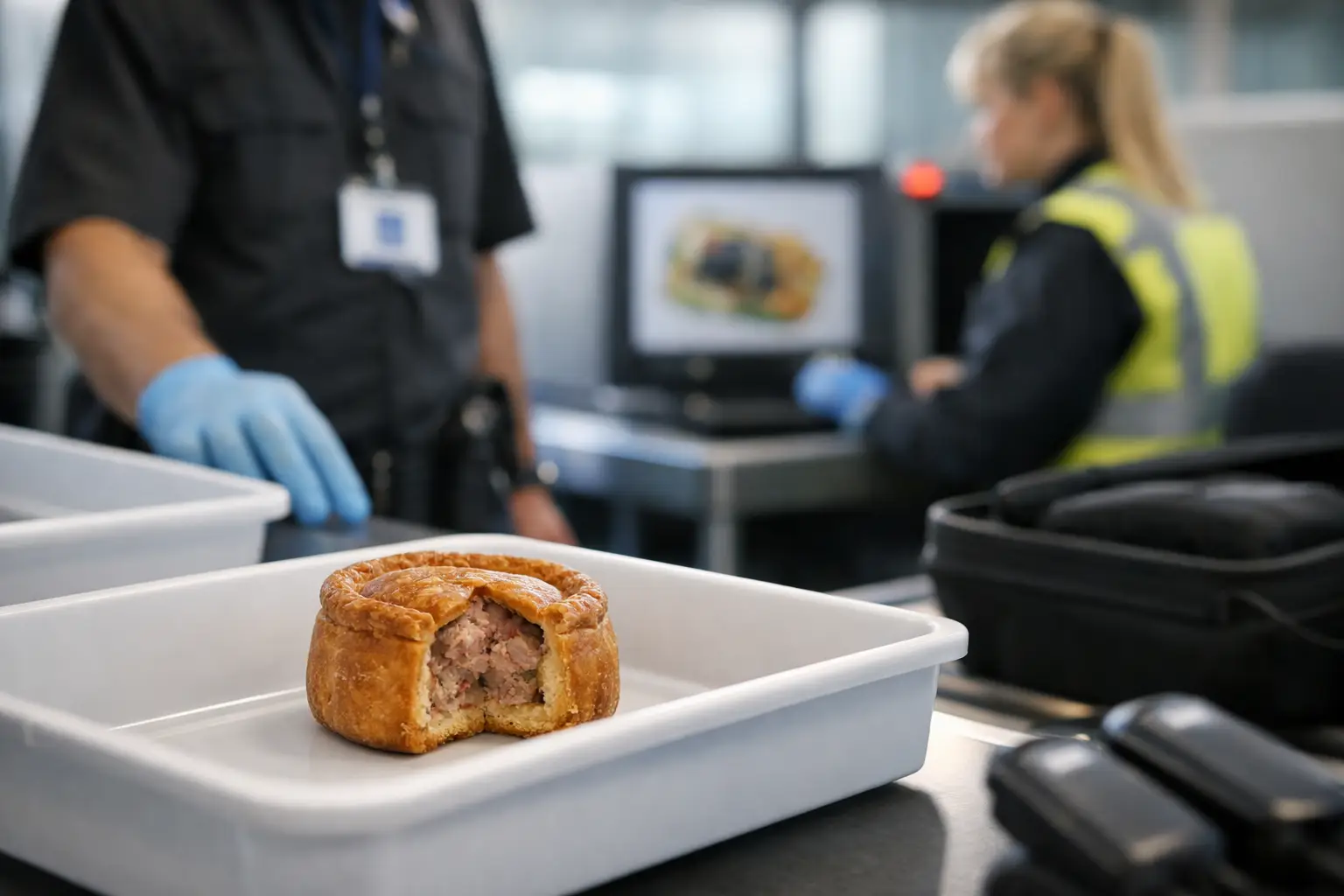
Passengers at Stansted Airport were briefly asked to remain calm on Tuesday after security seized a local man’s ‘emotional support pork pie’ before flight, leaving the owner visibly shaken and the pie, according to witnesses, “cool but dignified”.
By Our Security Correspondent: Ben Twarters
The incident, which is entirely fictional but already feels more plausible than several real airport policies, occurred shortly before the 6.15am Ryanair service to Alicante. Suffolk resident Darren Pargeter, 43, had reportedly placed the pork pie in a small travel cushion, complete with a tiny neck pillow and laminated card reading: “Please do not separate us. We have been through some things.”
Security staff initially believed the item was a standard snack. Matters escalated when Mr Pargeter insisted it was not food but “a registered emotional support pork product”, trained to assist him through departures, gate changes and the moment a stranger removes their shoes in public.
“I am not saying I need it to fly,” said Mr Pargeter, speaking from the landside Pret A Manger where he was attempting to compose himself with a £6.40 croissant. “I am saying that without it, I may have to make eye contact with other people in the departure lounge. That is a different matter entirely.”
Stansted airport security seizes emotional support pork pie
Airport officers were said to have remained professional throughout, although one reportedly had to turn away after being informed that the pie’s name was Sir Loin.
A spokesperson for the fictional Stansted Airport Pie Liaison Unit said staff must apply the same rules to every passenger, regardless of whether their companion is a sausage dog, a houseplant or a hand-raised pork pie from a farm shop outside Bury St Edmunds.
“Security regulations are clear,” the spokesperson said. “A pork pie may pass through screening as food, provided it has not been fitted with a lead, a waistcoat or a document identifying it as a source of unconditional emotional stability. Once a pastry item has a social media profile and a GP-style support letter, additional questions arise.”
Mr Pargeter had reportedly presented a note written on the back of a garden centre receipt. It stated that Sir Loin was “essential for calmness”, particularly during turbulence and when cabin crew announce that the card machine is not working.
The letter also claimed the pie could detect anxiety through “an advanced understanding of mustard”.
Security staff became concerned after noticing that the pork pie had a small brass bell attached to its crust. Mr Pargeter explained that the bell was only used if he became distressed, at which point Sir Loin would alert him to the availability of a pint once they landed.
“That is not a bell,” he told officers. “That is a therapeutic chime. There is a difference. Anyone from Suffolk knows that.”
A difficult separation at Departures
Witnesses described the final moments before the pork pie was placed into a clear evidence bag as “moving, but also extremely inconvenient for the queue behind”.
One passenger, who had been trying to get a family-sized bottle of sun cream through the scanners in a child’s sock, said Mr Pargeter made a short speech.
“He crouched down beside the tray and thanked the pie for its service,” she said. “Then he asked if he could at least take the lid. The officer said there was no lid. He said that was exactly the sort of cold bureaucratic language Sir Loin had warned him about.”
The airport has denied rumours that the pie was immediately eaten by a sniffer dog named Colin. It did confirm that all surrendered foodstuffs are handled in line with procedure, which, in Britain, usually means somebody puts them in a staff fridge marked ‘DO NOT TOUCH’ and then touches them by lunchtime.
A source close to the airport said Sir Loin was being held in a secure temperature-controlled facility alongside three bottles of Limoncello, a litre of homemade gravy and what appeared to be an entire trifle in a sports direct bag.
“People think airport security is just about liquids and laptops,” the source said. “They do not see the human side. Every day, officers must make difficult decisions. Is that a 100ml moisturiser? Is that yoghurt? Is that yoghurt with intent? And now: can a pork pie provide emotional support at 30,000 feet?”
The rise of the support snack
The case has triggered debate among travellers, pub regulars and the sort of people who own a lanyard for a reason nobody can quite establish.
Some believe Mr Pargeter should have been allowed to take Sir Loin on board, provided the pastry remained under the seat in front and did not attempt to use the armrest. Others have raised concerns that permitting emotional support pork pies could open the floodgates.
“If one pie gets through, what is next?” asked Elaine Wittering, chair of the Essex Association for Sensible Queueing. “Emotional support Scotch eggs? A companion Cornish pasty? You will have a man trying to board EasyJet with a lasagne in a baby carrier, saying it helps with his fear of enclosed spaces.”
It is a fair question. British society has long operated on an unspoken agreement that emotional support is best provided by tea, a carvery, or saying “could be worse” while staring into middle distance. Giving legal status to a picnic item may be a step too far, especially at an airport where passengers are already required to carry their dignity in a transparent plastic bag.
But supporters say the establishment has once again underestimated the quiet reassurance offered by a decent pie. Sir Loin, they argue, was not merely pastry, pork and a frankly ambitious amount of jelly. He was a familiar presence in an unfamiliar place. A small, portable reminder that one day the flight would end, the hire car paperwork would begin, and there would probably be chips.
Dr Clive Rummage, a self-appointed aviation wellbeing expert from Sudbury, said emotional support food should not be dismissed out of hand.
“People travel with lucky socks, teddy bears, headphones and an irrational confidence that their suitcase will appear on the belt,” he said. “A pork pie is simply more honest. It does not pretend to fix your anxiety. It sits there, quietly, containing meat.”
Pargeter vows to appeal
Mr Pargeter eventually boarded his flight without Sir Loin after purchasing two small bottles of water, a packet of salted almonds and a commemorative Stansted fridge magnet shaped like a runway. He said none of these had the “emotional depth or structural integrity” of his companion.
He has vowed to appeal the decision when he returns from Spain, although he admitted that this may depend on whether he remembers after a week of breakfast buffet prosecco.
“I am not asking for special treatment,” he said. “I am asking for basic compassion and perhaps a dedicated fast-track lane for passengers travelling with pork-based mental health arrangements.”
A petition calling for clearer rules has already been drafted in the comments section of a local Facebook group, beneath a separate argument about whether the A14 is worse than it used to be. It proposes that support pies be fitted with approved travel labels and offered a pre-flight counselling area near WHSmith, where they can sit quietly beside the meal deals and consider the nature of loss.
For now, travellers are advised to check their airline’s policy before arriving with any emotionally significant baked goods. A pork pie may be a comfort in troubled times, but at airport security, it is still safest to declare it, pack it properly and avoid giving it a name.