
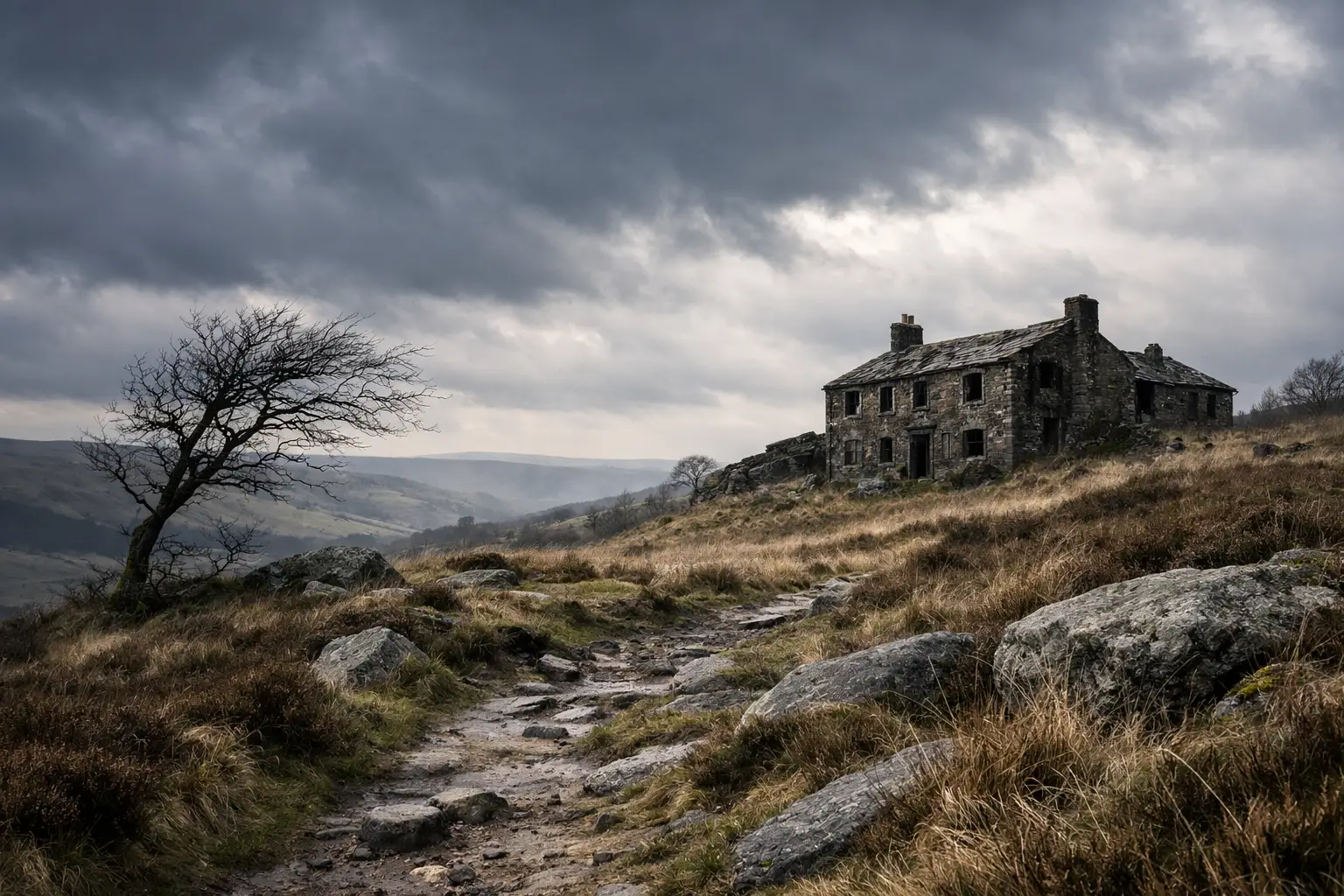
One does not simply “enjoy” Wuthering Heights. One survives it, emerges slightly wind-battered, and then spends a week arguing with friends about whether Heathcliff is a tortured romantic hero or simply the sort of man who would get barred from three pubs before lunch. Emily Bronte’s Wuthering Heights has that rare talent for making readers feel both intellectually enriched and personally attacked.
It is the novel equivalent of being shouted at by the weather.
Why Wuthering Heights still rattles people
Plenty of classics become cultural furniture. They sit in the corner looking respectable, occasionally dusted off by sixth formers and people who have started saying “actually” before every opinion. Wuthering Heights is not like that. It still feels unwell in the best possible sense – angry, damp, obsessive and faintly dangerous.
That is partly because it refuses to behave like the nice version of a love story people half-remember from school. This is not a tale of candlelit yearning and tasteful glances across a drawing room. It is a book full of emotional sabotage, inherited grudges, social cruelty and people making choices so bad they ought to come with a council warning notice.
Readers often arrive expecting romance and instead find revenge with weather. That shock is part of the appeal. Wuthering Heights remains fresh because it never settles into comfort. It bites.
The plot of Wuthering Heights, once you remove the wallpaper
At the centre are Catherine Earnshaw and Heathcliff, whose bond is intense, destructive and about as healthy as a diet consisting entirely of pints and spite. Heathcliff arrives at the Earnshaw household as an outsider and is never allowed to forget it. He and Catherine grow close with the sort of wild loyalty that only ever ends well in fiction if one of them moves to Devon and takes up pottery.
Instead, Catherine chooses to marry Edgar Linton, who is respectable, civilised and roughly the literary equivalent of a cream carpet. Heathcliff, understandably not thrilled by this development, disappears and returns with money, bitterness and a commitment to making everyone else’s life substantially worse.
What follows is not so much a love triangle as a multi-generational campaign of emotional arson. Families are manipulated, marriages are weaponised, children inherit old feuds and nearly everyone behaves as though therapy has been outlawed by Parliament.
If that sounds melodramatic, it is. But it is controlled melodrama, which is much harder to pull off. Emily Bronte does not merely fling suffering at the page and hope for the best. She builds a world where cruelty has structure, where class and power shape desire, and where love can become a method of possession.
Heathcliff: romantic icon or absolute nightmare
This is where pub rows begin. Heathcliff has been packaged in some corners of popular culture as the ultimate brooding lover, all intensity and windswept despair. That reading survives largely because people are very forgiving of men if they stare moodily at a hill.
On the page, he is more complicated and much less safe. Heathcliff is brutal, vindictive and deeply wounded. He is capable of devotion, yes, but also of calculated misery. He does not merely suffer. He exports suffering to others on an industrial scale.
That is what makes him interesting. A sanitised Heathcliff would be useless. The novel needs his ugliness. Wuthering Heights is not asking readers to approve of him. It is asking them to face what happens when humiliation, exclusion and obsession are given years to harden.
There is, of course, a trade-off in how modern readers approach him. If you read for romantic fantasy, he is alarming. If you read for psychological force, he is unforgettable. The trouble comes when people insist those are the same thing.
Catherine is not the heroine people expect
Catherine often gets flattened into the girl torn between passion and security, as though she is trapped in a period drama trailer with violins swelling in the background. In fact, she is stranger and sharper than that. She is selfish, vivid, contradictory and frequently impossible.
Her famous declaration about Heathcliff works because it is not a tidy confession of love. It is a statement about identity, ego and belonging. Catherine does not simply want Heathcliff. She experiences him as part of herself. That makes their bond powerful, but also monstrous. Once love becomes selfhood, any separation feels like mutilation.
Emily Bronte gives Catherine enormous force without making her pleasant. That still feels radical. Women in classic fiction are often forgiven if they suffer beautifully. Catherine suffers noisily, damages others and remains magnetic anyway.
Class, snobbery and the great British pastime of looking down on people
For all its gothic storms and ghostly whispers, Wuthering Heights is also a novel about social rank. Heathcliff is degraded not just because individuals are cruel, but because class gives that cruelty legitimacy. He is treated as lesser, spoken down to, and kept in a position others can exploit.
That makes the novel feel startlingly current. Britain has changed its wallpaper but kept much of its snobbery. We still pretend class is either dead or terribly vulgar to mention, right before deciding somebody’s worth from their accent, school or whether they say “settee” without irony.
In Wuthering Heights, class is not decorative context. It drives the tragedy. Catherine’s decision to marry Edgar is bound up with status. Heathcliff’s revenge is fuelled by exclusion. The younger generation inherit not just property but the social damage done by those divisions.
The book understands something Britain still does not love admitting – humiliation lingers. It breeds. It learns the route back.
Why the structure feels so odd, and why that matters
A less daring novel would tell this story directly. Wuthering Heights instead gives us layers of narration, with Mr Lockwood hearing the tale from Nelly Dean, who has her own perspective, blind spots and occasional talent for sounding like somebody reporting a village scandal while also helping cause it.
This structure matters because it keeps the novel unstable. No one simply hands you the truth. You receive fragments, prejudices, recollections and judgements. That makes the book feel less like a moral lesson and more like overhearing a family history in which every speaker has edited themselves for public consumption.
It also adds to the newspaper quality of the whole business – witness statements, hearsay, a suspiciously confident narrator and a general sense that everyone involved may be minimising their own role in events. Suffolk Gazette readers will recognise the genre immediately.
The moors are doing more than looking dramatic
There is always a temptation to treat the landscape as scenic garnish, as though the moors exist merely to provide a brooding backdrop for windswept declarations. In truth, the setting is central to the novel’s mood and meaning. The wildness outside reflects the instability within. Wuthering Heights itself feels battered, exposed and inhospitable. Thrushcross Grange, by contrast, offers polish, comfort and manners.
This is not subtle, and it does not need to be. Bronte sets up two environments and asks what kind of people each one produces, shelters or ruins. Nature here is not calm and restorative. It is unruly, cold and indifferent. Very British, really.
That tension between wildness and control runs through the entire book. The characters are constantly being sorted, disciplined, inherited, married off or judged, and yet something stubborn and ungovernable keeps pushing through. The weather gets the headline, but the real story is about failed containment.
Why people keep coming back to Wuthering Heights
Partly because it is excellent, which helps. But also because it does not flatter the reader. It offers no easy moral glow, no straightforward lovers to back, no neat comfort that virtue will sort things out by chapter thirty. The novel trusts that readers can handle mess.
It also changes depending on when you read it. As a teenager, you may respond to its extremity and think everyone else is simply too sensible. Later, you notice the damage adults do when they confuse intensity with destiny. Later still, you start seeing the machinery of inheritance, resentment and social power. It is one of those books that ages with you, though not always politely.
And there is something liberating about a classic that refuses improvement. Wuthering Heights has not been made nice by history. It remains furious, peculiar and faintly feral. You can admire it, dislike it, argue with it or fling it across the room, but indifference is hard to manage.
If you are returning to Wuthering Heights after years away, read it without the bonnet-and-heather myths attached. Read it as a savage novel about love curdled by class, grief and ego. Then make a cup of tea, stand by the window looking grim, and accept that some books were never meant to comfort you – only to leave the air changed.