
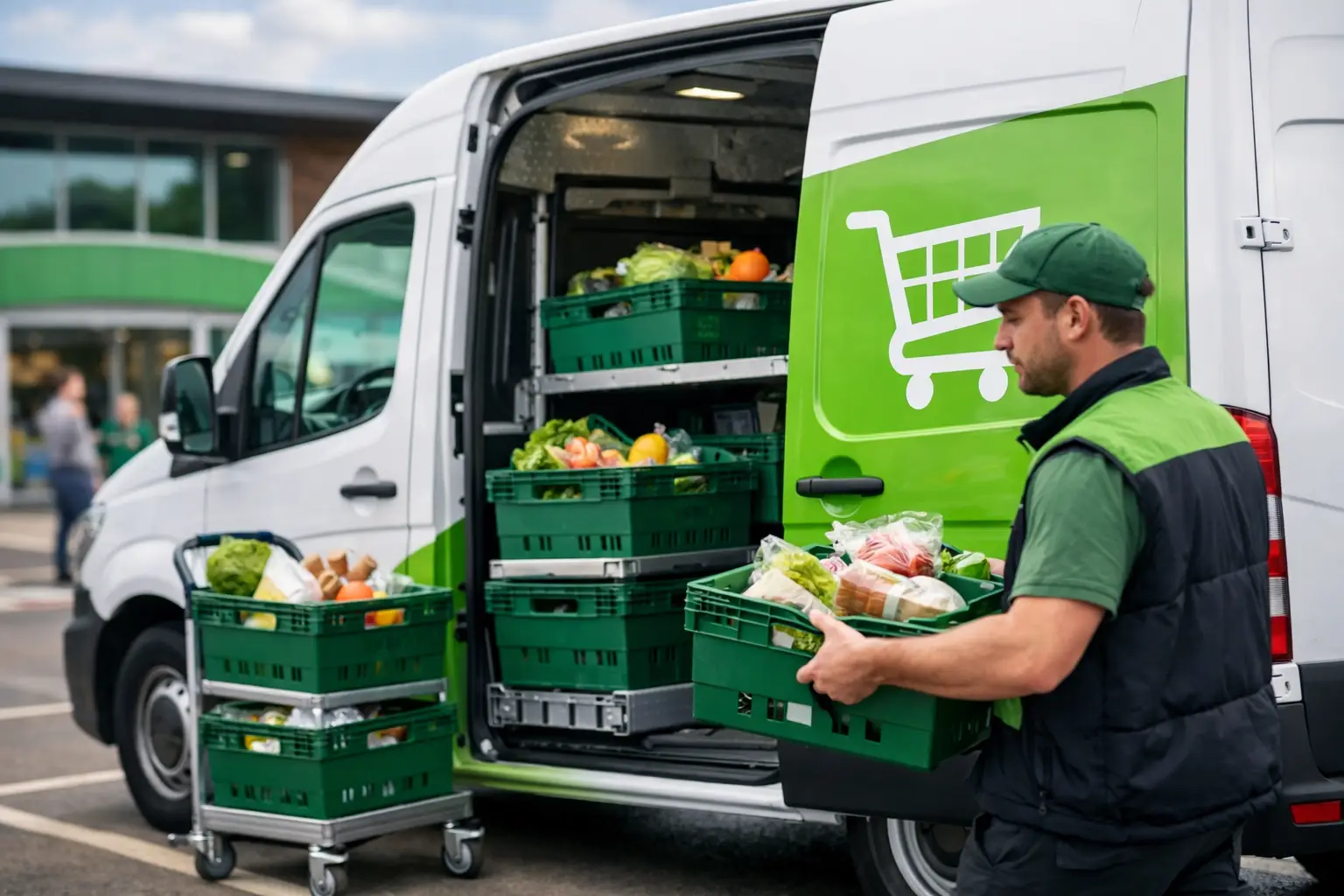
Residents across Suffolk have reacted with the steady, resigned fury usually reserved for council parking notices after learning that Asda’s new two-hour delivery rule means the driver now sits on your sofa until you unpack. The supermarket giant, according to baffled shoppers and one man from Stowmarket who described himself as “still processing the yoghurt aisle emotionally”, has introduced a policy requiring delivery drivers to remain in the customer’s home until every item has been removed from the crate, inspected, and placed somewhere that feels right.
By Our Norfolk Reporter: Ian Bred
The measure, said to be part of a wider efficiency drive dreamt up by somebody with a spreadsheet and no friends, is designed to ensure the handover of groceries is “fully completed” within the two-hour slot. In practical terms, this means a stranger in a green fleece now watches you decide where exactly the beetroot goes, occasionally offering thoughts on cupboard management and whether your bananas are in a healthy relationship with the avocados.
One Felixstowe woman said the experience began normally enough, with the driver bringing in six trays of shopping and apologising for the lack of mint sauce. “Then he just stayed,” she said. “I laughed and said, ‘You can leave those there, love,’ but he sat down on the sofa, folded his arms, and said he was unable to depart until I’d found a permanent home for the fusilli. By the time I got to the cleaning products he was giving me sensible advice about under-sink zoning.”
Why Asda’s new two-hour delivery rule means the driver now sits on your sofa until you unpack
Asda insiders, all of whom spoke on condition of anonymity and because this is obviously made up, said the rule emerged after head office concluded too many deliveries were being technically completed while shoppers were still doing that thing where they stare into a carrier bag as if hoping a cupboard fairy will handle the rest. A pilot scheme reportedly found customers could spend up to 47 minutes pretending they had a system before simply shoving biscuits next to batteries and calling it a day.
A spokesperson in a hi-vis bodywarmer said the new arrangement creates “greater accountability at the point of domestic grocery integration”. When pressed on what that actually means, they clarified that drivers now have a duty to see the process through from doorstep to drawer, including, where necessary, sitting quietly in the lounge while the customer mutters, “That can’t be where cumin lives,” for the third time.
There are, naturally, conditions. Frozen items must be put away first, chilled goods second, ambient groceries third, and anything from the middle aisle that no one remembers ordering must be discussed openly. Drivers are also understood to have discretion to intervene if eggs are placed on top of tins, bleach is stored near teabags, or someone attempts to create a “snack shelf” that is plainly just a pile.
Drivers say the sofa stage is the hardest part
For delivery staff, the policy has transformed a straightforward route into something closer to low-stakes couples counselling with strangers. One driver serving Ipswich, Woodbridge and the villages in between said the most difficult deliveries were not the heavy ones but the households that “make unpacking a personality”.
“You get invited in, fair enough. Then suddenly you’re part of a domestic referendum on whether jam belongs in the fridge,” he said. “Last Tuesday I was in Kesgrave for 38 minutes while a bloke debated where to put four individual limes. At one point his wife asked me to settle it and I said fruit bowl, because I wanted to see my children again.”
Others claim the role now demands a far broader skill set than previously advertised. New recruits are said to be receiving training in awkward small talk, kitchen diplomacy, and the correct facial expression when a customer says, “Don’t judge me, but the crisp cupboard is upstairs.” Existing staff have reportedly adapted by carrying a polite smile, a firm understanding of pantry ergonomics, and the emotional stamina of a parish clerk.
One veteran driver from Lowestoft said sofa placement itself is critical. “Never take the armchair,” he explained. “That looks presumptuous. Three-seat sofa, left cushion, slight forward lean. It says, ‘I’m a professional, but I’m also monitoring where the pesto goes.'”
Customers divided over the living room supervision scheme
Reaction has been mixed. Some shoppers have welcomed the extra support, especially those who live alone or have long suspected their kitchen layout was being held together by denial. A retired couple near Sudbury said their regular driver had become “a calming influence” during Wednesday deliveries and had gently persuaded them to stop storing gravy granules with lightbulbs.
“He’s marvellous,” said the husband. “Knows exactly where the chopped tomatoes should go. Frankly, I trust him more than I trust myself.” His wife agreed, adding that it was “nice to have a professional eye” on the biscuit tin situation, though she admitted the atmosphere became strained when he rejected her emergency trifle shelf as “emotionally understandable but structurally weak”.
Others, however, feel the policy goes too far. A Bury St Edmunds man described the moment he realised the driver was not leaving as “deeply unsettling in a very British way”. “You can’t just ask someone to go, can you?” he said. “So we ended up having tea while I sorted out the yoghurts. Then he met the dog, commented on our lampshades, and stayed long enough to hear my daughter say we only buy own-brand cola when guests aren’t important.”
Several residents also raised concerns about performance anxiety. The presence of a uniformed witness, they say, has turned ordinary unpacking into a public examination of private habits. Cupboards once flung open with confidence are now approached like legal evidence. People who had happily lived for years with pasta in three locations are suddenly being made to defend themselves.
The two-hour window now includes emotional unpacking time
Consumer experts, local gossips and one woman in Diss who comments beneath every Facebook post have all noted that the phrase “two-hour delivery window” has taken on a very different meaning. Where it once referred to the likely arrival of groceries, it now covers the full theatrical production: the anticipation, the handover, the sorting, the muttered regrets, and the final moment where the driver stands in the hallway and says, “Right, that all looks lovely,” as if reviewing a village fete.
There is talk that the scheme could be expanded. Trial documents allegedly mention a premium service in which the driver not only observes but actively participates, handing over items one by one and making neutral statements such as “interesting choice” when confronted with 14 tins of rice pudding. A family package may include fridge shelf optimisation, freezer Tetris, and a quiet but meaningful pause before anyone stores onions next to potatoes.
An even more ambitious rollout, rumoured but not confirmed, would see delivery staff authorised to challenge chaotic households in real time. Under the proposed rules, a driver could ask whether five open packets of couscous are truly necessary, or suggest that owning three separate mustards is the behaviour of somebody avoiding deeper issues. As yet, Asda has not commented on whether the service will extend to airing cupboards, garage chest freezers, or that one drawer full of batteries, takeaway menus and resentment.
What shoppers in Suffolk are being told to do now
For now, customers are advised to prepare for deliveries by having a clear plan, a sensible route to the kitchen and, if possible, at least one cupboard that can be opened without shame. Experts say it also helps to rehearse a few casual phrases, such as “we’re between systems at the moment” and “the spice rack’s only temporary”, both of which may reduce the chance of visible concern from the man unloading your crumpets.
Those unwilling to unpack under observation can still choose the click and collect option, though this does come with its own indignities, chiefly being handed 19 bags by a teenager who has seen exactly how much grated cheese you consume in a normal week.
In the meantime, households across the county are adapting as best they can. Sofas are being tidied. Cupboards are being audited. Relationships are being tested by the sudden need to present a united front on where the stock cubes live. It is, in many ways, the most intimate supermarket development since loyalty cards started revealing that someone in the house has a secret Viennese whirl problem.
If nothing else, the alleged policy may finally force the nation to confront a truth long buried beneath multipacks and mild denial: unpacking the shopping was never a task. It was a character test. Best put the kettle on before the driver arrives.