
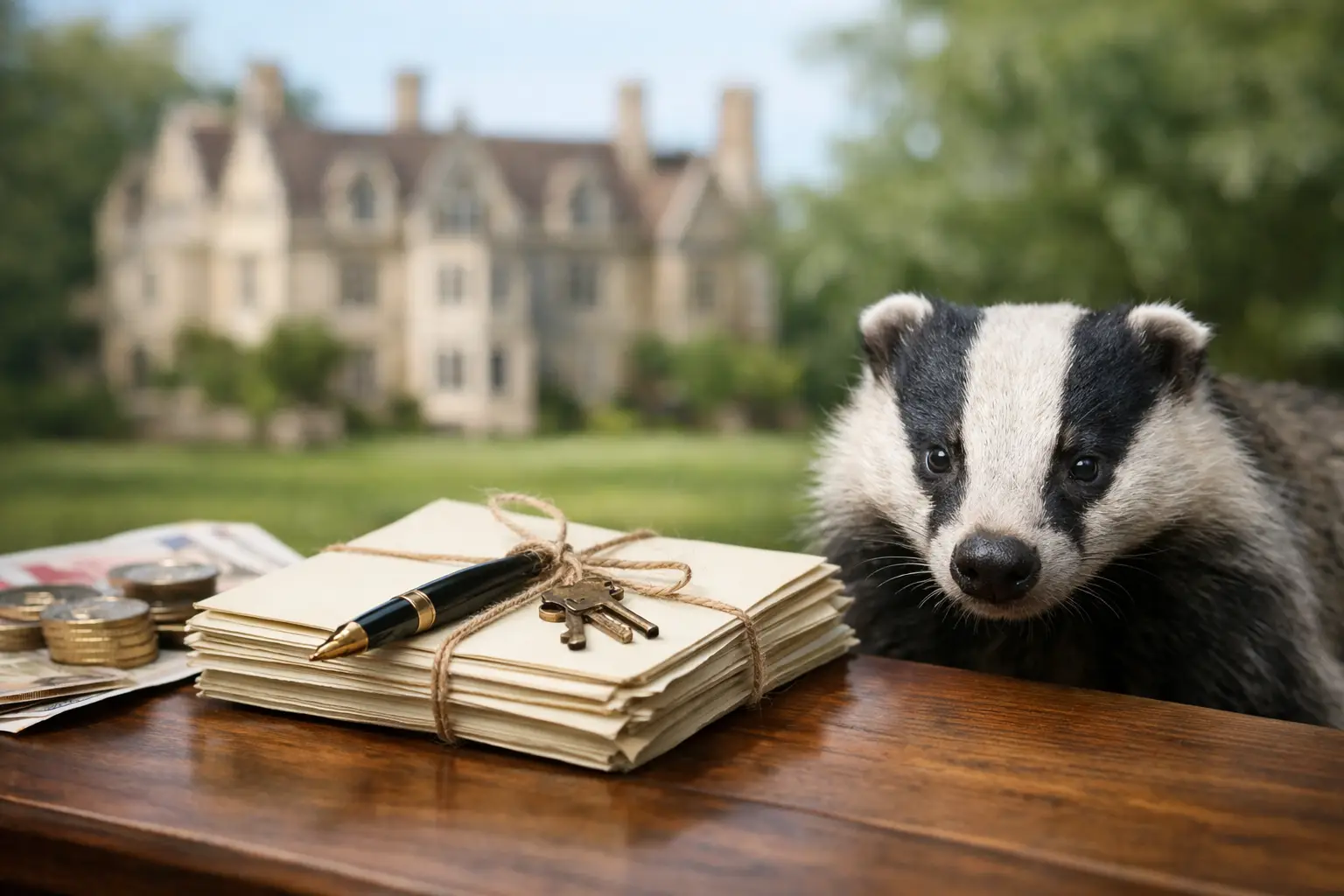
A retired carpet salesman from near Stowmarket has reportedly tackled inheritance tax loopholes UK-style by leaving his entire £1.8 million estate to a local badger called Clive, who has been seen twice behind the recycling bins at the former man’s bungalow.
By Our Property Correspondent: Ruth Tyler
The will, written in blue biro on the reverse of a Sainsbury’s petrol receipt, states that the beneficiary is to receive “the house, the savings, the Vauxhall, the shed full of bolts and, naturally, the burden of maintaining the ornamental pond”.
It also asks that no member of the family attempt to “have a little word” with Clive, who is understood to be grieving in the manner of a badger: by ignoring everyone and demolishing a hedge.
Inheritance tax loopholes UK residents had somehow missed
The deceased, 74-year-old Gerald Pottle, had spent the last decade telling neighbors that the tax system was “a racket designed by people with clipboards”. He had reportedly become concerned that his children might one day spend their inheritance on “a holiday somewhere with a wristband”.
Instead, Mr Pottle began making regular deposits into the undergrowth at the edge of his garden, initially in the form of bread crusts and latterly through a complicated series of cash-filled biscuit tins. He then developed what he described to friends at the Crown and Sceptre as “a perfectly legal wildlife-based fiscal arrangement.”
Nobody at the pub had the heart to tell him that a badger cannot normally own a three-bedroom detached property, open an ISA or be called upon to produce photo identification at the building society. They had, however, heard worse financial plans from men who had recently watched one documentary about cryptocurrency.
Local solicitor Diane Fenn said the document had presented “one or two administrative curiosities”.
“Clive has not yet attended our office,” she said, looking towards the car park with the fixed expression of somebody who has spent all morning explaining probate to a man dressed as Henry VIII. “We have left several messages beneath a wheelie bin. So far, his response has been non-committal but very earthy.”
The family’s position
Mr Pottle’s son, Trevor, said he was “not bitter”, while standing outside the bungalow in a gilet and measuring the windows for reasons he insisted were unrelated.
“He always liked that badger,” Trevor said. “Dad said Clive listened without interrupting, never borrowed the lawnmower and understood that Radio 4 had gone downhill. But to leave him the whole lot? There’s a conservatory in there. A badger doesn’t even appreciate a conservatory.”
Mr Pottle’s daughter, Sharon, has challenged the will on the grounds that Clive may not be the same badger named in the document. She claims there are at least three similar-looking animals in the area, all of whom have “the same shifty little face”.
A wildlife expert, who asked not to be named because he was supposed to be discussing bats at a parish council meeting, confirmed that badgers are notoriously difficult to distinguish once they have acquired property portfolios.
“People assume the facial stripes make it easy,” he said. “But that is exactly the sort of complacency that gets you into a boundary dispute with an animal that has claws and no interest in mediation.”
A tax plan with a few holes in it
While Mr Pottle’s strategy has been praised by several men in the comments section of the village Facebook group, experts have warned that inheritance tax planning is usually more complicated than bequeathing your estate to whichever mammal has made the strongest impression near your compost heap.
For a start, an estate does not simply avoid tax because its new owner can tunnel. There are rules around gifts, trusts, charities, beneficiaries and the small matter of whether the beneficiary is capable of understanding the phrase “sign here”. There is also the inconvenient possibility that the intended badger is not a legal person, despite displaying more common sense than certain members of the House of Lords.
Ms Fenn said people should be especially cautious about treating pub lore as financial guidance.
“Someone hears that their cousin’s neighbour put a caravan in their daughter’s name in 1997 and suddenly they are redrawing the constitution,” she said. “Then we are asked whether a tortoise can be executor. It cannot. Not because of the law, necessarily, but because it would take all year to get to the postbox.”
The Suffolk Gazette understands that Mr Pottle had considered several other arrangements before settling on Clive. These included giving the house to a scarecrow, converting the garage into an independent republic, and leaving the pension to “the last remaining person who knows how to repair a cassette player”.
His final choice may have been influenced by a falling-out with a neighbour over a fence panel, during which Clive was the only creature present not to offer an opinion.
Clive’s first week as a landowner
Since the will became public, the badger has reportedly been spotted entering the property through a gap beneath the side gate at around 2.15am. Witnesses said he appeared calm, focused and possibly interested in the patio furniture.
Estate agents have already suggested that the bungalow could be marketed as “a characterful country residence with established sett access and one unusually committed incumbent”. One firm proposed a guide price of £675,000, provided Clive agrees to vacate for viewings or at least stops hissing at couples from Cambridge.
The Vauxhall presents a different challenge. Although technically part of the estate, Clive has no driving licence and has shown little interest in the vehicle beyond chewing the rear mudflap. Insurers are understood to be reluctant to quote for a policy where the registered keeper has no fixed address but does possess a powerful digging arm.
The matter has now reached the local council, which has been asked whether a badger can pay council tax. A spokesman said the authority had no specific guidance, but added that it would still send the bill, followed by three increasingly stern letters and a leaflet about bins.
The legal battle moves underground
Trevor Pottle has proposed a settlement in which Clive retains the vegetable patch and a lifetime supply of mealworms, while the family receives the house, the savings and the ornamental pond. Clive has not responded, though he did leave a sizeable excavation beneath Trevor’s prized hydrangea.
Negotiations have been complicated by an intervention from the local Badger Appreciation Society, whose chairwoman believes the animal is being “unfairly expected to behave like a conventional homeowner”.
“Clive has had a lot thrown at him,” she said. “Probate forms, family resentment, a driveway he never asked for. Let him process this in his own time. Preferably beneath a shed.”
For now, the bungalow remains in limbo, its curtains drawn and its garden increasingly re-landscaped by a beneficiary with strong views on drainage. There are rumours that Clive plans to let the spare room to a fox, although this has not been independently verified and would almost certainly cause parking difficulties.
Anyone considering inheritance tax arrangements is gently advised to speak to a qualified professional rather than a nocturnal animal, however trustworthy its whiskers may appear. And if you must leave a fortune to a badger, at least make sure it knows where you keep the key to the shed.