
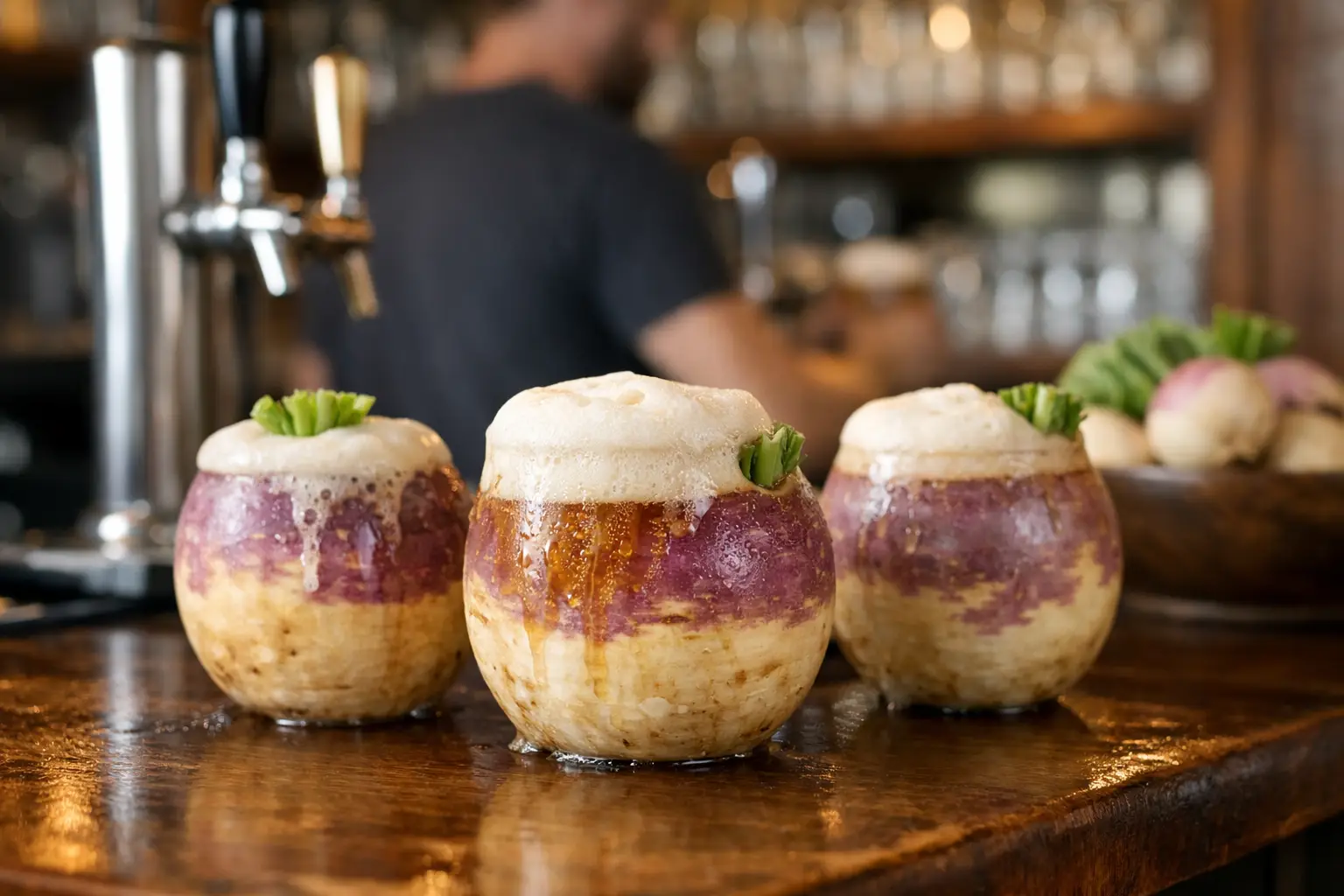
The latest Plastic Free July updates have forced a Suffolk pub to serve beer in turnips after a council recycling leaflet was allegedly read all the way to the end.
Bu Our Consumer Correspondent: Colin Allcabs
The Crown & Cabbage in Lower Stowupland began the scheme on Monday, replacing plastic pint glasses, disposable straws and, briefly, the landlord’s reading glasses with hollowed-out root vegetables sourced from a man called Trevor near Needham Market.
By Tuesday lunchtime, drinkers had accepted that a pint of bitter arriving in a turnip was not, strictly speaking, worse than receiving it in one of those festival cups that smells of old coins. By Wednesday, however, the pub’s darts team had demanded an inquiry after three pints of lager rolled off the table and lodged beneath the fruit machine.
Landlord Gerald Pottle, 61, said the decision was made after staff became “frightened by the plastic”.
“People say they want pubs to do their bit,” he told reporters, while spooning froth from a particularly ambitious swede. “Well, we are doing our bit. We have done the bit, the next bit and several bits nobody asked for. You cannot say this place is not environmentally conscious when the customers are literally holding vegetables.”
Plastic Free July updates leave pub without a glass
The confusion began when the Crown & Cabbage received an email suggesting venues should consider reducing single-use plastics during July. According to Mr Pottle, the message contained the phrase “think outside the bottle”, which he interpreted as a direct instruction to remove all familiar drinking vessels from the building.
Within hours, the pub’s pint glasses had been placed in a locked cupboard marked “FOR AFTER THE PLANET”. A local farm shop was then contacted for “about 90 containers with the tops cut off”.
The first delivery consisted of turnips, swedes, three marrows, a pumpkin the size of a parish councillor’s head and a crate of beetroot which management rejected on grounds of “alarming implications for upholstery”.
Regular customer Keith Muddle said he admired the intention, although his half of Adnams had developed a faint earthy finish by the time he reached the quiz question on maritime flags.
“It is a lovely pint, don’t get me wrong,” said Mr Muddle, holding a dripping turnip at arm’s length. “But you have to drink it quite quickly, because after ten minutes the vessel begins to make decisions of its own. Mine has gone soft around the handle area.”
His wife Brenda, who ordered a gin and tonic in a radish, was less diplomatic.
“I asked for ice and the barman put in two frozen peas,” she said. “That is the sort of thing that makes people vote Reform by accident.”
A sustainable future, briefly interrupted by gravy
Pub staff insist the initiative has been broadly successful. The establishment has reported a 100 per cent reduction in plastic cups, a 74 per cent rise in conversations about allotments and an unconfirmed increase in customers saying “you couldn’t make it up” before taking photographs.
Barmaid Chloe Snaith said the only serious operational difficulty was keeping the turnips upright. Traditional bar mats were deemed too plastic-adjacent, while a trial involving egg boxes resulted in what one inspector called “a spreadable scene”.
“You cannot stack them like glasses,” Ms Snaith explained. “You have got to cradle them. Then somebody asks for a round of six, and suddenly you are a midwife in a cardigan.”
The pub has introduced a deposit scheme, although no one appears entirely sure how it works. Customers pay £1.50 for each turnip and receive the money back if they return it in a condition suitable for another drink. This has led to lengthy arguments over whether a turnip with teeth marks is “contaminated”, “weathered” or “showing character”.
One customer successfully returned his vessel after taking it home, roasting it with rosemary and bringing back the empty skin in a sandwich bag. The pub accepted it after a brief meeting of the management committee and a call to a man in Bury St Edmunds who used to work for Defra.
The situation worsened during Sunday lunch service, when two diners accidentally poured their cider over roast pork and declared it the best gravy in Suffolk. A third attempted to order a large Malbec in a butternut squash, describing it as “more of a bowl situation”.
Mr Pottle said the pub would not be deterred by “minor sogginess”.
“People laughed when we banned plastic stirrers. They laughed when we replaced napkins with leaves. They laughed when we asked the Morris dancers to stop shedding bells near the salad. But this is what progress looks like – slightly damp, orange on the inside and attracting wasps.”
The community responds with predictable restraint
Not everyone is convinced. The Lower Stowupland Parish Environmental Working Group has praised the pub for “initiating a conversation”, but stressed that the conversation ought not to involve “an uncovered pale ale inside a root crop during fly season”.
Meanwhile, the Suffolk Campaign for Real Ale has offered cautious support, provided the vegetables are local, seasonal and do not alter the beer’s fundamental right to taste of disappointment and Thursday.
Spokesman Derek Fenn said: “There is history here. Beer was once drunk from tankards, horns and whatever the Vikings had to hand. A turnip is perhaps not the obvious heir to that tradition, but neither is a luminous blue plastic cup with the logo of an energy drink on it.”
A delegation from a nearby gastropub has visited to study the idea. Its chef is reportedly considering a premium package in which customers receive a small ale served inside an edible baby turnip, followed by a bill of £14.95 and a speech about provenance.
From pint pot to plot-to-pint
For all the jokes, the pub says it has learned a valuable lesson about waste. The vegetables, once their drinking careers are over, are collected for composting by a local smallholder, except those that have been claimed by customers for stew, emotional reasons or evidence.
There have also been unexpected benefits. The pub garden is now popular with children, who can watch discarded turnip cups slowly become part of the soil while their parents wonder whether this counts as education. A robin has taken up residence near the smoking area and appears to be drinking the residue from abandoned shandies.
Mr Pottle accepts that the scheme may not last beyond July. The hot weather has made storage difficult, and the pub’s cellar manager has warned that a delivery of 200 swedes could be mistaken for a hostile takeover by a greengrocer.
Still, he believes the experiment has made people think. “Every time someone asks why their lager is in a turnip, we tell them it is because we care about the planet. Every time they ask for a normal glass, we tell them that is exactly the kind of attitude that got us here. Then we give them a coaster and apologise.”
The pub is planning a final Plastic Free July celebration this weekend, featuring acoustic music, meat raffle tickets printed on old receipts and a special cocktail served in a hollowed-out onion. Customers are advised to book early, bring both hands and avoid wearing white.
If you find yourself offered a drink in a vegetable, the sensible approach is to support the sentiment, keep the turnip above waist height and finish before it becomes a side dish. The planet may not be saved by one soggy pint, but at least the compost heap will have a decent story to tell.