
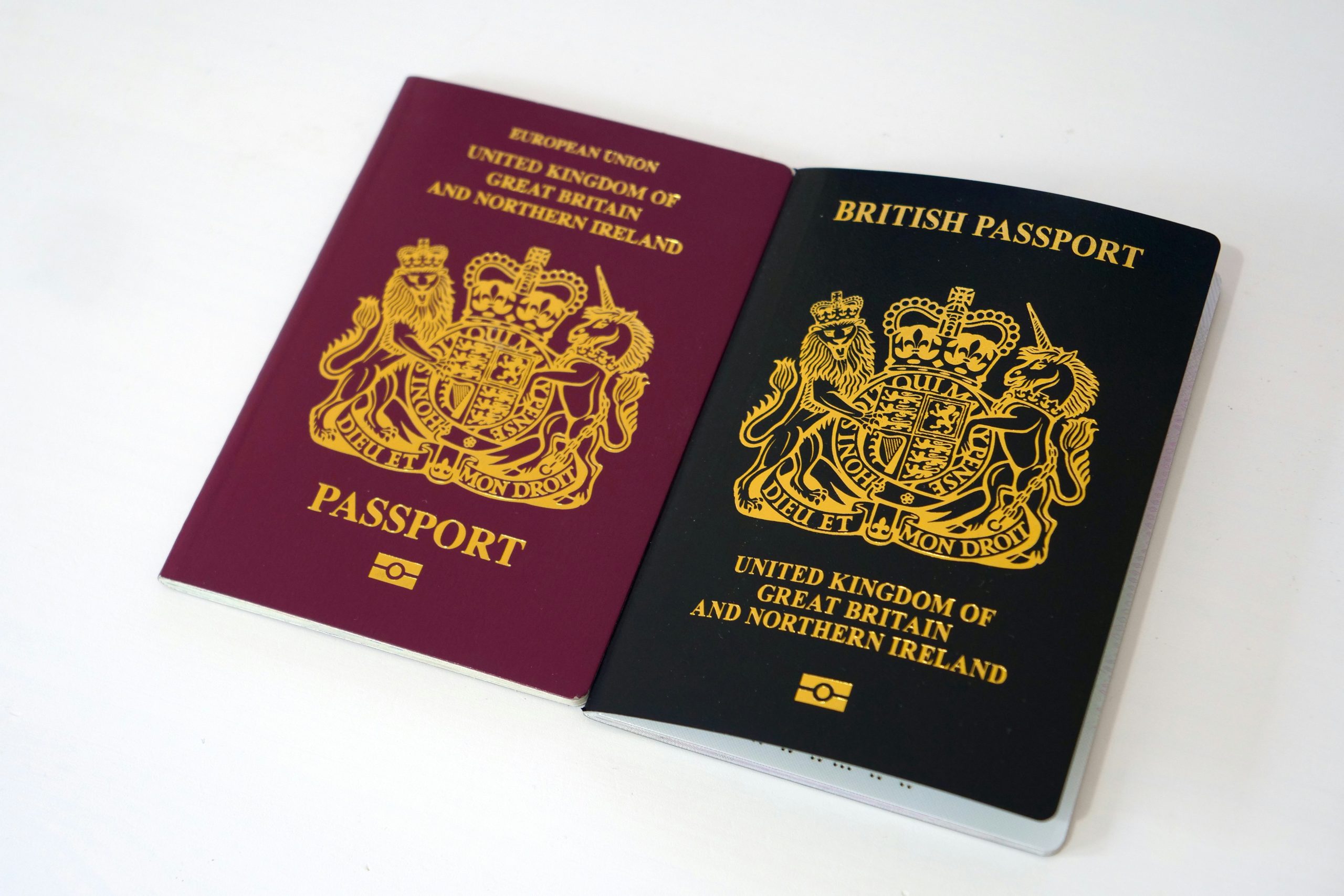
This article is satire. Please do not ring the passport office about the stamp, the queue, or the council.
By Our Economics Editor (on secondment from the Peking Times): Foo Tse
IPSWICH – Passport renewal track application delays blamed on single missing stamp have left one Suffolk man in administrative limbo after officials reportedly discovered that his 1989 application folder was “almost perfect, except for one tiny square of ceremonial ink”.
The missing stamp is believed to have been intended for Box 14C, a section of the form which no longer exists, concerns a holiday to Majorca that never happened, and was last seen by a civil servant called Derek in 1994.
Yet without it, according to the Passport Continuity and Mild Regret Directorate, the entire renewal process cannot proceed. Not slowly. Not provisionally. Not even with the usual British compromise of putting a Post-it note on it and hoping somebody more senior retires before Friday.
Local resident Colin Fenn, 61, applied for a renewed passport in March after finding his existing one had expired shortly before he intended to use it for a long weekend in Bruges and an opportunity to buy three bottles of beer he could not pronounce.
Five months later, he has received 14 emails, six identical letters, a plastic wallet marked “URGENTISH”, and one telephone call in which an automated voice sighed heavily before disconnecting.
“It is not the delay that gets you,” said Mr Fenn, speaking from his kitchen table beside a growing pile of photocopies. “It is the confidence with which every person says they are unable to tell you what the stamp was, who issued it, or whether stamps still exist. One lady asked if I had tried checking behind the fridge.”
Passport renewal delays and the stamp nobody can name
Officials insist the hold-up is regrettable but essential to national security, international co-operation and the continued existence of a filing cabinet in Peterborough labelled ‘MISCELLANEOUS BUT VITAL’.
A spokesperson, wearing the expression of someone who has personally explained a PDF to a magistrate, said the missing stamp could relate to any number of serious matters. These include a former address, a counter-signatory, a passport photograph judged too cheerful, or proof that Mr Fenn had not once attempted to cross the Channel using a laminated library card.
“The system has identified an irregularity,” the spokesperson explained. “When a system identifies an irregularity, we respect it. We do not ask the system why it has identified the irregularity, because that can make it upset.”
The Track Application service, introduced to give applicants a clear, modern indication of where their documents are, currently shows Mr Fenn’s status as: “Received, assessed, queried, reconsidered, escalated, de-escalated, awaiting historical clarification.”
Underneath this, in smaller type, appears the reassuring message: “You do not need to contact us.”
Mr Fenn said he had tried not contacting them for three weeks, following official advice. “It was extremely difficult at first. I would wake up at 3am and think, perhaps today is the day they realise that a single missing stamp is not a threat to the constitutional order. But then I would remember I am dealing with a department that still sends letters to confirm it has emailed you.”
The stamp may have been last used under John Major
The Gazette understands the stamp was probably applied at a regional passport desk in 1992, during a period experts refer to as “the Great Ink Confidence”. At the time, British administration was enjoying a brief experimental phase in which every form was given a coloured box, every letter came with carbon paper, and no official instruction could be considered binding unless it had been struck with enough force to dent the desk beneath it.
Former passport clerk Maureen Tibbles, who worked in an office above a carpet warehouse near Chelmsford, believes the missing mark could be the legendary Oval of Acknowledged Intention.
“It was a little purple thing,” she said. “Or green. We had purple on Tuesdays and green whenever Brenda had hidden the purple pad in the biscuit drawer. The stamp meant we had seen the form, though not necessarily read it. It was a simpler time.”
Mrs Tibbles added that the stamp had been phased out after a 1997 review found that nobody could explain its purpose, but nobody felt able to throw it away in case it was linked to Belgium.
That decision now appears to have consequences for Mr Fenn, whose planned trip has already become progressively less ambitious. Bruges became Hull. Hull became a day out at Bury St Edmunds. Bury St Edmunds has been postponed pending proof of identity at the car park machine.
His wife, Sharon, said the situation had changed him. “Colin used to be quite a calm man. Now he starts every conversation by asking whether I have signed anything in black ink lately. Last week he accused the toaster of failing to retain supporting documentation.”
Suffolk residents form a queue support group
Mr Fenn is not alone. A support group has formed outside an Ipswich café every Thursday, bringing together people whose passport applications have been paused by anomalies too minor to describe without sounding entirely invented.
One woman said her application was awaiting confirmation that a staple removed in 2008 had been removed “with consent”. Another was told the middle initial on her birth certificate differed from the middle initial she had never had. A retired teacher from Woodbridge has been asked for a clearer copy of a photograph taken in 1976, despite pointing out that 1976 itself was not especially clear.
The group has adopted the name STAMP, which stands for Suffolk Travellers Awaiting Meaningful Progress. Members share tea, compare reference numbers, and speculate about what happens inside the passport tracking system after 4.30pm.
“Nothing,” said group organiser Neil Pargeter. “That is not criticism. It is simply the strongest available evidence.”
The Department has rejected suggestions that applications are being delayed because they are checked by one overworked official equipped only with a magnifying glass and a large wooden pencil. It says there are several officials, and at least one has access to a second pencil.
Still, a leaked internal memo, apparently written on the back of a meeting agenda about printer toner, advised staff to “avoid resolving cases too quickly, as this may create expectations”. The memo also reminded employees that a stamp is not missing until it has been searched for in the basement, the archive basement, and the special basement where old basements are held.
A breakthrough, of sorts
On Tuesday, Mr Fenn received fresh correspondence from the Passport Continuity and Mild Regret Directorate. It stated that the missing stamp may not be required after all, provided he can submit a certified declaration from someone who remembers seeing it.
Unfortunately, the declaration must be countersigned by a registered professional who has known Mr Fenn for two years, is not related to him, does not live near him, has never met him socially, and can confirm the visual characteristics of an object that disappeared more than three decades ago.
Mr Fenn remains hopeful. “My old neighbour used to work at the Co-op and has an excellent memory for stamps,” he said. “Not passport stamps, admittedly. Mostly Green Shield. But at this stage I would accept a witness statement from a moderately trustworthy spaniel.”
For readers facing an actual passport renewal, the sensible move is less theatrical: check the current official requirements early, keep copies of what you send, and allow more time than feels remotely reasonable. And if anyone asks for the Oval of Acknowledged Intention, make a cup of tea first. You may be there a while.