
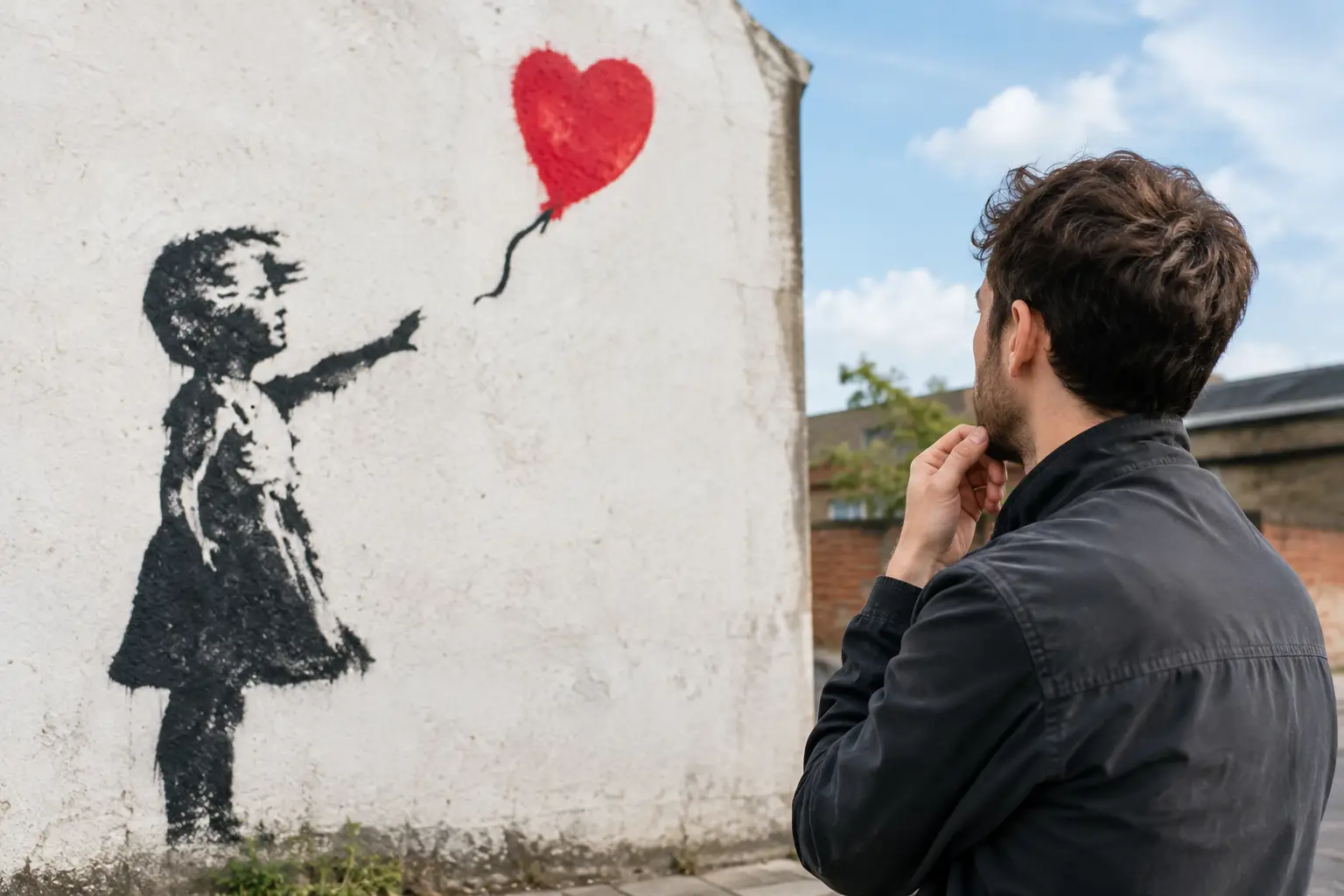
The Banksy exhibition Colchester 2026 shock reached a fresh and frankly avoidable peak yesterday after a local Norfolk man became confused by art on walls, having assumed walls were simply where art went when it had nowhere better to be.
By Our Crime Editor: Rob Banks
Dennis Pargeter, 58, from a village outside Dereham that residents insist is not technically Dereham, arrived at the exhibition with his wife, a packed lunch and the sort of facial expression normally reserved for a council letter about wheelie bins.
Within seven minutes, he had asked whether the first three stencils were “still being put up”, whether a painted rat had escaped from the catering area, and why nobody had the decency to frame anything.
“You spend all that money on a building,” Mr Pargeter told reporters, standing in front of a work reportedly valued at £4.2 million, “then somebody draws on the actual wall. It’s like when young Callum got hold of the felt-tips at Christmas, except apparently this chap’s been allowed to carry on for twenty-odd years.”
The exhibition’s staff, trained in crowd management, contemporary art interpretation and gently separating visitors from installations, confirmed that Mr Pargeter had not touched the exhibits. He had, however, offered to fetch a tin of magnolia “before the landlord sees it”.
Banksy exhibition Colchester 2026 shock baffles experts
The Colchester show, which has brought works, recreations, projections, merchandise, queues and at least four men saying “my daughter made me come” to the town, was expected to attract art lovers from across Essex and beyond.
It did not anticipate Dennis.
Curator Lucinda Frobisher said the exhibition was designed to prompt questions about power, consumerism, surveillance, war, inequality and the peculiar ability of a red balloon to make people briefly forget they are in a converted retail unit near a pay-and-display car park.
“Mr Pargeter has absolutely prompted questions,” she said. “Chiefly, ‘Can somebody explain perspective to him without escalating the situation?’ But that is the beauty of public art. Everyone brings their own experience to it. Dennis brought a tuna baguette, a flask and a deep suspicion of anything without a visible price label.”
The misunderstanding reportedly began in a room containing a wall-sized recreation of a Banksy piece showing a child playing with a weaponised cultural symbol, or possibly a commentary on innocence, violence and the commodification of dissent, depending on which information board one had time to read before Dennis began asking where the “proper pictures” were.
“I said to the lady, ‘That looks like graffiti,’” Mr Pargeter explained. “She said, ‘Yes, that is partly the point.’ Well, it’s partly the point with my garage door too. The point is, some oik’s done it in the night.”
His wife, Maureen, later confirmed that Dennis had been “like this since Norwich Castle put those modern things in”.
“He likes a landscape,” she said. “A windmill. A horse. Maybe a bowl of fruit if it’s painted realistically and not looking as though the fruit is disappointed with the Government. He went to London once and complained the Tate had too many empty rooms. I said they were installations. He said that was even worse.”
A close encounter with a gift shop
The visit took a more serious turn in the gift shop, where Mr Pargeter encountered tote bags featuring anti-capitalist imagery priced at £28.
Witnesses said he stood perfectly still for nearly a minute, perhaps experiencing the rarest of all British conditions: ideological vertigo.
“He kept picking up this mug with a stencil of a riot policeman on it,” said assistant manager Callum Reece. “Then he said, ‘So the message is capitalism’s bad, is it?’ I said that was one reading. He said, ‘And the other reading is that this is eighteen quid before tea.’ Honestly, he was not wrong. Annoyingly, he was not wrong.”
Mr Pargeter did not purchase the mug. He did buy a pencil for £3.50, believing it to be “the only honest item in the room”, before learning that it came in a cardboard sleeve printed with the phrase ‘Question Everything’.
“I questioned the price,” he said. “That seemed to satisfy everyone.”
A spokesman for the exhibition insisted the shop was an optional part of the visitor experience, although he declined to comment on reports that the exit route had been designed by somebody who considered the concept of choice to be an interesting historical curiosity.
Norfolk man proposes practical solution
After completing the exhibition, Mr Pargeter presented staff with what he called “some constructive feedback”. His plan involves moving all artwork onto canvases, placing a modest brass plaque beneath each one, and putting anything political in a separate room “for people who’ve got the energy”.
He also recommended that any piece involving rats should carry a warning for those who have recently eaten at a railway station.
Most controversially, he suggested installing one traditional oil painting near the entrance “so people can settle in”. His preferred subject would be a Suffolk Punch in a field, although he accepted that this might prove difficult if the artist in question was committed to anonymity, social critique and deploying images of rodents with greater international recognition than several Cabinet ministers.
The proposal has divided Colchester’s cultural community. One local artist called it “a chilling demand for aesthetic reassurance”. Another said it was “not a terrible shout, actually”, before admitting she had spent the previous weekend painting a Victorian goose in a hat for a pub commission.
The town council has not formally intervened, but an unnamed official said it was watching events closely, largely because it had received six complaints about signage, two questions about parking and a strongly worded email from a man who thought Banksy was appearing in person “like Antiques Roadshow”.
Not every wall needs saving
By late afternoon, Mr Pargeter appeared to have made a tentative peace with the art world. He conceded that one image, involving a small girl and a balloon, had been “quite moving in a way I don’t entirely trust”.
He also admitted that the exhibition had made him think, though he was keen to clarify that this was not necessarily a recommendation.
“There was one bit about people buying things they don’t need, and I thought, fair enough,” he said. “Then we walked straight into a room selling Banksy umbrellas. That’s clever, I suppose. Or appalling. Probably both. You can’t say it hasn’t got you looking.”
Before leaving, Dennis was spotted studying a small stencil near the final gallery. He leaned in, adjusted his glasses and asked whether it was “meant to be there”. A nearby visitor replied that this was precisely the question Banksy wanted people to ask.
Dennis considered this for a moment.
“Well,” he said, “that’s handy. I’ve been asking it all afternoon.”
Art, as ever, may not solve anything. But if it gets a Norfolk man to pause before recommending magnolia, it has probably done enough for one day.
Meanwhile: Mr Tumble rumoured to be Banksy