
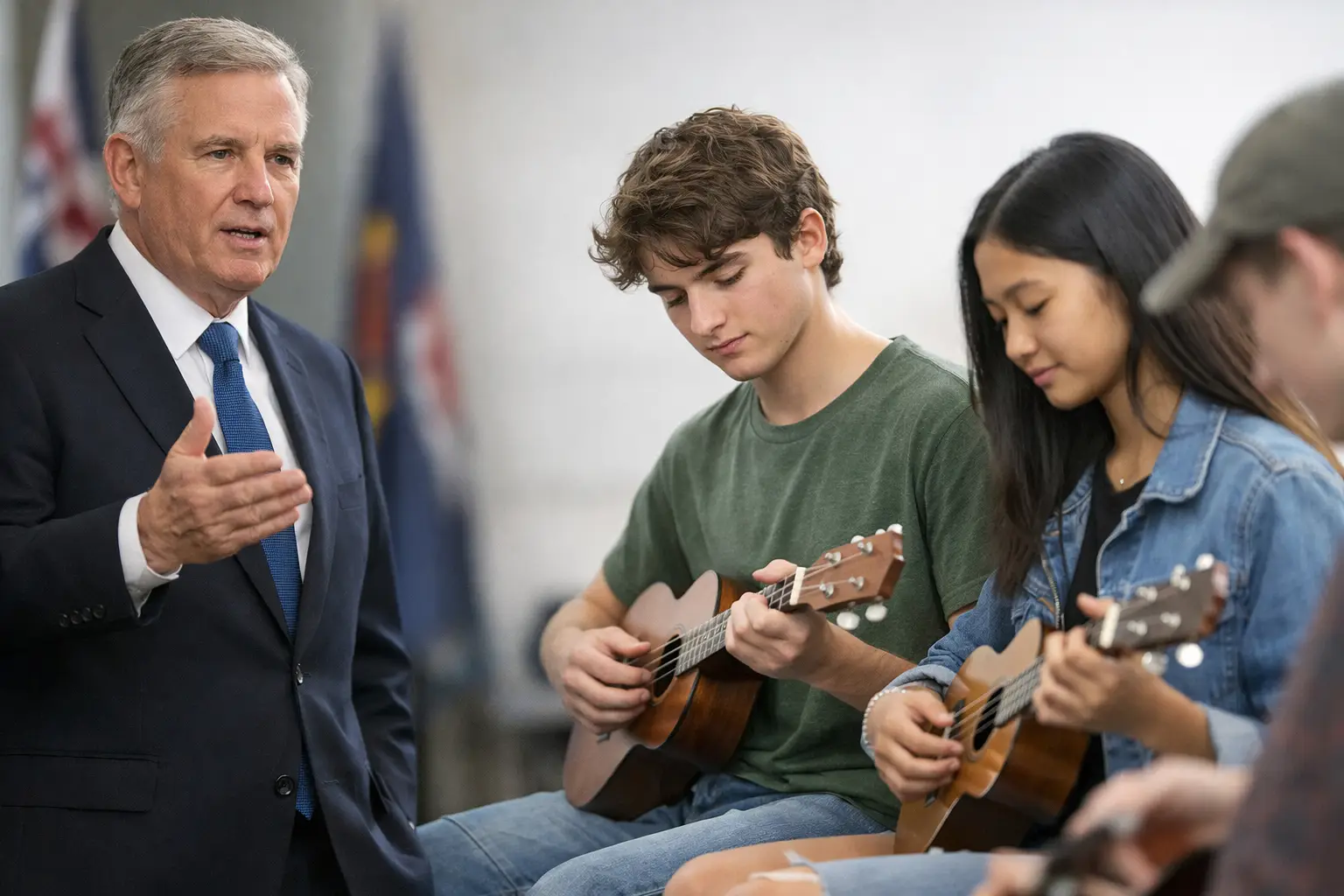
Andy Burnham, prime minister, orders jobless teens to learn ukulele under a new back-to-work scheme designed to replace awkward silences with C major.
By Our Political Correspondent: Polly Ticks
The policy, called Get Britain Strumming, will reportedly require unemployed 16 to 24-year-olds to attend two weekly lessons in a converted Jobcentre cupboard, where they will learn the basics of rhythm, posture and pretending not to know Wonderwall.
Ministers insist the programme is not punitive. “Nobody is being forced to enjoy themselves,” said a spokesman, while standing beside a flipchart reading: A nation that strums together, earns together. “But if a young person can play three chords and make eye contact with a pub landlord, they are clearly ready for the modern economy.”
Andy Burnham’s jobless teens ukulele plan
Under the proposed rules, claimants will be issued a government-standard soprano ukulele, a plastic folder and a laminated card containing the words “Have you tried weddings?” in large reassuring type.
Those who complete the eight-week course will receive a Level 1 Certificate in Portable Cheerfulness, which ministers believe could open doors across the hospitality, busking and low-level corporate team-building sectors. The qualification will also confirm that its holder can play Riptide at a speed suitable for a village fete queue.
A pilot scheme in Greater Manchester allegedly produced mixed but encouraging results. Of the 40 participants, 11 found casual work, seven formed a folk-pop collective called Universal Credit Union, and one was hired by a garden centre to play softly beside the reduced compost.
“It was either this or another course on writing a CV,” said 19-year-old participant Jayden, tuning his instrument with the haunted concentration of a man trying to access his online benefits account. “At least this one comes with a bag. The CV course just gave us a pen that didn’t work.”
The Prime Minister’s office says the initiative will eventually be expanded into a wider cultural employment package. Young people who show promise may progress to tambourine, cajón or, in exceptional circumstances, a glockenspiel funded through a special levy on people who say they are ‘between projects’.
A sensible response to an increasingly unserious economy
The policy arrives after months of concern that Britain’s young people are being left behind by an economy that expects applicants to have five years’ experience in jobs invented last Tuesday. Ministers say conventional employment support has become too focused on such old-fashioned notions as vacancies, training and employers answering their phones.
“Britain has always succeeded when it has recognised a new industry early,” said a Cabinet source. “We did it with steam, we did it with finance, and now we are doing it with four nylon strings and a mildly optimistic Instagram bio.”
The Treasury estimates that every ukulele player could generate up to £14.60 of local economic activity per afternoon, mostly through the purchase of flat whites, vintage shirts and a single packet of crisps in a pub that has reluctantly started hosting acoustic Sundays.
Officials were keen to stress that the calculations were independently verified by a man called Darren who runs a craft beer taproom in Leigh and has “quite a good feeling about it”.
Critics have queried whether the scheme offers enough support for young people facing genuine barriers to work, including housing costs, poor transport, insecure jobs and the fact that every entry-level role now requests ‘a dynamic self-starter with Adobe Creative Suite’.
The Government replied that these were serious matters and had therefore been referred to a cross-departmental working group, which will meet next spring in a room above a Pret and begin every session with a quick strum of Three Little Birds.
Suffolk prepares for a wave of compulsory cheerfulness
In Suffolk, local councils are already preparing for a possible influx of newly trained performers. Ipswich town centre has identified several suitable sites for supervised strumming, including outside the closed bank, near the pigeon with one leg, and the bit by the bus station where somebody is always shouting about broadband.
A council document seen by absolutely nobody suggests that each market town could be allocated a rotating Ukulele Work Experience Zone. In Bury St Edmunds, participants may be placed outside an artisanal bakery to accompany the purchase of a £5.80 sausage roll. In Felixstowe, they could perform sea shanties for day-trippers who have not asked for them. In Sudbury, there are hopes that a chord progression might finally be found capable of calming the A134.
One anonymous Suffolk employer welcomed the plan cautiously. “I run a small independent shop selling candles shaped like vegetables,” she said. “Could I use a part-time ukulele person? Potentially. Would I pay them a living wage? Let’s not get carried away. This is Britain.”
Meanwhile, the county’s existing ukulele community has reacted with the sort of quiet alarm normally reserved for a coachload of hens arriving at 9.45am.
“We support music for everyone,” said the chairman of the East Anglian Strummers Association. “But there is a difference between encouraging young people to make music and releasing 300 beginners into a public square with a booklet of Ed Sheeran arrangements. Society has rules.”
What happens if they refuse to play?
The question on everybody’s lips, after “where is the nearest loo?”, is whether teenagers who decline ukulele lessons will face sanctions.
Ministers insist that attendance is entirely voluntary, although those who opt out may be invited to a mandatory career conversation with a contractor whose office carpet has the emotional temperature of a police interview room.
Alternative instruments will be available for those with a medical, religious or deeply personal objection to the ukulele. Options include recorder, triangle and, for claimants deemed ready for leadership, a small set of bongos. No provision has been made for bass guitar because, according to one official, “we are trying to get people into work, not a progressive rock band”.
There will also be exemptions for young people who can demonstrate that they already own a vintage typewriter, have started a podcast about Roman Britain, or describe themselves as a ‘creative entrepreneur’ with sufficient confidence to be invited onto daytime television.
The opposition called the plans “a cynical distraction”, before accidentally releasing its own leaked proposal to teach under-25s the ocarina. Several newspapers immediately declared this a decisive policy difference.
For all the jokes, the plan has revealed a rare point of national agreement: young people deserve more than being told to simply try harder in an economy built by people who bought houses for £38,000 and still complain about the price of a pint.
Whether a ukulele is the answer remains doubtful. But if the country is determined to make a noise while it waits for a proper jobs strategy, it may as well learn to keep time.